A+ A A-
  • Written by Madelaine Bullwinkel

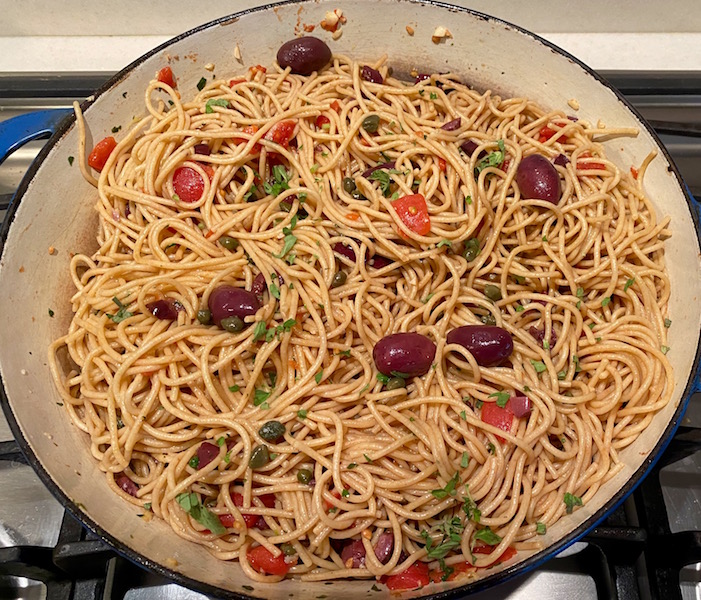
STAY-AT-HOME PASTA WITH OLIVES AND CAPERS
 

We are nearing the end of our second week in virtually lock-down conditions with no end in sight.  New restrictions in Chicagoland limit access to large public parks, golf courses and playgrounds. Are we completely protected from contact with the coronavirus?  Not quite. 

The supermarket, that last remaining arena of social contact, is coming under closer  scrutiny.  Food ingredients themselves are not the likely vectors for disease.  Transmission risks lie on surfaces other people have touched including food containers and, of course, fellow shoppers themselves.  Here is a list of good practices I've assembled to help you minimize risks when shoppping:  

  • Only shop once a week. (That has to be the hardest one to follow)
  • Pull on nitrile gloves before entering the market. Discard them before returning to the car.
  • Wipe off the handle of the shopping cart with the sanitizing wipes provided at the door. 
  • Practice six foot distancing from others while shopping.
  • Give purchases a sanitizing wipe when unpacking home. 

Finally, we are ready to cook!

I am delighted to pass along an easy pasta recipe sent in by long-time blog reader Nancy Cunov. All of us stay-at-home cooks long for a sauce packed with the ripe Mediterranean flavors of tomatoes, olives and capers. This is a satisfying dish hiding in plain sight. Most of the ingredients are already in your refrigerator or pantry. Preparation time is minimal. How hard is it to open a can?   

Nancy added one sentence of directions with the list of ingredients for this recipe.  You are allowed to do that when you’re Italian.  Making sauce for pasta is coded in your DNA.  The rest of us need a little guidance which I’m happy to contribute.  Thank you so much, Nancy!

WHOLE WHEAT SPAGHETTI WITH TOMATOES, OLIVES AND CAPERS

1 pound spaghetti (Terra Bona whole wheat, preferred)

1 cup pasta cooking water

2 tablespoons olive oil 

1 clove garlic (or more), minced

1 cup canned diced tomatoes 

1/2 cup chopped black olives (kalamata)

2 heaping tablespoons capers (packed in vinegar)

1/2 teaspoon kosher salt, ground pepper to taste

2 tablespoons fresh basil or oregano, finely chopped OR 2 teaspoons dried

Cook the pasta in 4 quarts boiling water with a tablespoon of kosher salt to an al dente consistency  Ladle out and reserve a cup of cooking water before draining the pasta.  Turn the pasta into bowl and toss with 1 tablespoon olive oil.  Reserve.

Saute the garlic pieces in the remaining tablespoon olive oil for 1 minute in a deep skillet.  Stir in the tomatoes and cook for 2 -3 minutes as the tomatoes render their juices.  (If you are using dried herbs, stir them in now.)  Add the pasta and toss until well mixed.  Pour in as much pasta cooking water as needed to distribute the tomatoes and lubricate the pasta. Fold in the olive pieces and capers; continue cooking and folding until all the ingredients are heated through.  Add salt and grind on pepper, to taste.  Stir in the fresh herbs and cook another 30 seconds.  Garnish with additional whole olives and serve.

Please continue to send me your stay-at-home recipes.  We’re in this together!
 

  • Written by Madelaine Bullwinkel

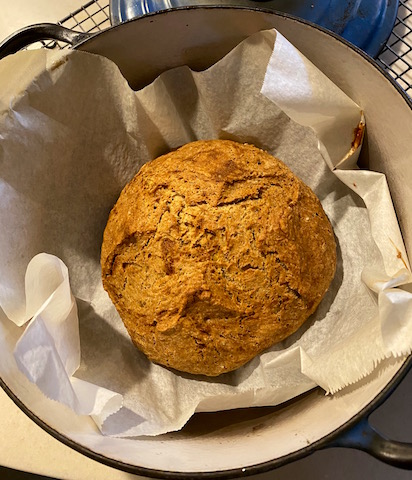
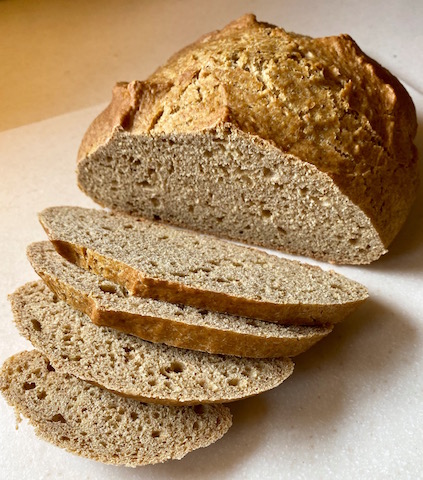
STAY-AT-HOME BROWN SODA BREAD


More supermarket shelves were bare here in America’s heartland over the weekend.  It came as a shock to see rows of empty self-serve steam tables and display cases vacant of fresh fish and meats.  What’s going on?  

 We can only surmise that food supply and delivery systems are disrupted as workplaces close to protect employees from the spread of the coronavirus. What if I can’t find my favorite brand of steel cut oatmeal next time I shop?  In the face of this level of uncertainty, I have only one recourse.  I bake bread.

You may be surprised to learn that a simply delicious loaf of Brown Soda Bread takes less time and effort than baking a batch of chocolate chip cookies.  (You will thank me for this advice if you take it.)  Soda bread has street creds too.  Before the Irish attached their name to it, a soda bread recipe had appeared in America’s first cookbook, The Virginia Housewife in 1824.  Today the Society for the Preservation of Irish Soda Bread (they’re for real) insists that the true recipe consists of flour, salt, baking soda and buttermilk.


 Soda bread dates from a time when bread was baked in a covered pot over an open fire or  nested among hot embers.  I spent a morning some time ago watching a black cook prepare an entire meal over a spacious hearth in the George Whyte House at Colonial Williamsburg.  Cooking as if conducting an orchestra, she worked intuitively, shifting the height and distance of various pots from the fire while simultaneously monitoring its heat.

That kind of intimate interaction led to the discovery and formulation of chemical leaveners in the 19th century,   At some point an attentive observer realized that the hissing sound from liquid spilling onto hot ashes was a chemical reaction worth containing.  The baking powder we purchase today contains bicarbonate of soda (from ashes) and two mild acid compounds that combine in the heat of the oven to create carbon dioxide bubbles that cause the bread to rise.  Voila!

BROWN SODA BREAD

1 cup unbleached white flour

1 1/4 cup whole wheat flour

1 teaspoon brown sugar

1 teaspoon baking soda

1/2 teaspoon baking powder

1/2 teaspoon salt

3/4 cup buttermilk (or 1 tablespoon lemon juice or vinegar stirred into milk)

1 large egg

2 tablespoons butter, melted

Preheat the oven to 375 degrees.  Place your largest, heaviest Dutch oven (cast iron is the best) in the oven with its cover on.

Stir together the flours, sugar, baking soda, baking powder and salt in a mixing bowl.  If using milk acidulated with lemon juice or vinegar rather than buttermilk, let the mixture stand for 10 minutes before blending in the egg.

Make a well in the center of the dry ingredients, pour in the buttermilk and egg liquid as well as the melted butter. Mix the liquids briefly then fold the dry ingredients into the wet until combined.  Turn the dough out onto a lightly floured work surface.  Dust your hands with flour, and lightly knead the dough for a minute or so adding more flour by the tablespoon until you can work it and keep your hands almost dry.  Shape the dough into a cushion, transfer it to a sheet of parchment and score the top 1/2” deep.

Remove the pot from the oven, uncover and carefully drop in the dough into using the parchment as support.  (Generously spritz the dough with water if you have a mister.)  Cover the pot and return to the oven for 40 minutes.  Remove the Dutch oven, uncover, lift out the bread and parchment liner.  Slide bread off the paper onto a rack and allow it to cool to room temperature. 

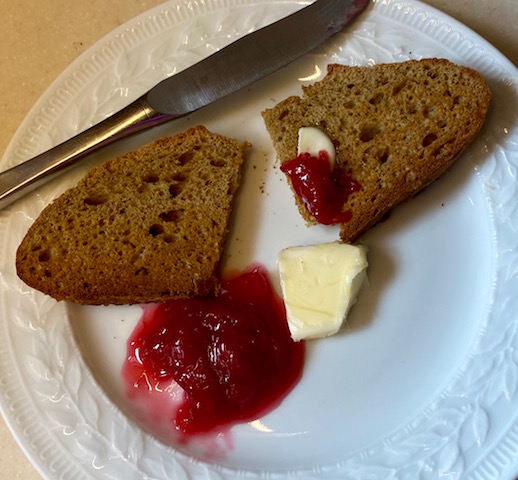
Serve in thin slices with butter and homemade jam.

 BONUS: RHUBARB GINGER JAM

 Ingredients for 1 1/2 cups

1 pound fresh rhubarb, trimmed at both ends and cut into 1” long pieces

1 cup sugar

3 strips lemon peel

2 slices ginger root, unpeeled, the size of quarters

1 tablespoon lemon juice

1/4 cup diced crystallized ginger (optional)

Jam:  Combine and stir together the rhubarb pieces, lemon strips, ginger root slices and 1/3 cup sugar in a 4 quart saucepan.  Cover the pan and allow to stand for 30 minutes.

Bring the fruit and accumulated juices to a simmer and cook, barely simmering for 10 minutes.  Add the remaining sugar in two installments allowing the jam to return to a boil before adding more. Stir regularly to prevent sticking.  Add the lemon juice and continue cooking until almost all of the excess juices have reduced, before the jam starts to stick to the bottom.  Off the heat, pour the jam into a two cup measure.  

Pour the jam to within 1/2” of the rim of each jar.  If the edge has a drop of jam on it, wipe it clean with a paper towel dipped in the hot water bath.  Attach the lid, screw the cap on tightly and invert the jar for 15 seconds (to sterilize the air remaining in the jar) before returning it right side up to the rack.  Store cooled  jars in dark, cool place  The jams taste best if consumed within 6 months.  They make great gifts!  You can also store jam in unsterilized jars in the refrigerator.

Prepare preserving jars in advance:  3 quarter-pint quilted jars, or 1 1/2 pint and 1 quarter-pint jar.  Submerge them in boiling water for 15 minutes.  (A pasta pot with an slotted insert is the best container because jars won’t bounce around on the bottom.)  Let jars cool on a rack, dip the jar lids in the boiling water and then cool on a rack.  Screw caps do not have to be sterilized.

Link to more recipes for baking powder breads 


  • Written by Madelaine Bullwinkel

EMPTY-THE-REFRIGERATOR FRIED RICE


Our stay-at-home status has forced everyone to confront the contents of their refrigerator.    I suspect that resulted in the senseless stampede to the supermarket to buy toilet paper and bottled water rather than deal with cooking leftovers.  What recipe includes toilet paper and bottled water?  I’d rather not think about it.

Happily for readers of this blog, Katheryn Weiss, responded swiftly to my call for easy recipe for the homebound with  Empty-the-Refrigerator Fried Rice.  Thank you, thank you Katheryn. 

 The proportions of the ingredients, order of their addition and quick timing are more important than the ingredients when making this dish.   Rice is the usual base but another grain or dal would work.  I substituted striped bass for meat and salad vegetables (carrots, cucumber and radish) in place of mushrooms and asparagus.  You will need an egg or two and soy sauce. 

The photo at the top of the page illustrates my ‘test drive’ of Katheryn’s recipe. The directions worked as did the timing,  The results were delicious.

 What’s on your table?  Please feel free to contribute.  A recipe and photo of the finished product is all that’s required.  While I wait, I’m going to clean my refrigerator.

 EMPTY-THE-REFRIGERATOR FRIED RICE

1 cup cooked white rice, cooled
2 tbsp cooking oil divided (peanut, olive, whatever you have)
1/4 cup or more of dry white wine or chicken stock
1 leek (white part only) sliced in half and then sliced thinly (or sub onion or shallots)
1-2 garlic cloves, minced
1-2 cups of cooked meat, chopped. I used some leftover steak, chicken and pork loin
1-2 cups of vegetables, chopped into bite-sized pieces, if necessary. I used some asparagus and a package of mushrooms that were on their last legs.
1 tbsp soy sauce
1-2 eggs, lightly beaten (I only used one because I'm rationing)
3-4 green onions, sliced
Salt
Pepper
Prepared Asian condiment, if desired

Prepare a cup of white rice and set aside to cool.
Dice leftover meat, mix with soy sauce, add pepper to taste and set aside.
Heat 1 tablespoon oil in a large skillet.  Add leek and sauté on medium until golden. Add wine or chicken stock and stir. Add additional vegetables and sauté until brown (2-3 minutes). 

Add 1 tablespoon of oil. Stir in egg(s) and quickly scramble them. Fold in diced meat with soy sauce and rice. Cook on medium heat until rice is heated through and ingredients are well blended. Season with salt. Add a spoonful or two of Asian condiment, if desired. I had some fermented chile sauce in the 'fridge.

Fold in half the scallions and scatter remaining scallions on top. Serve.