A+ A A-
  • Written by Madelaine Bullwinkel

STAY-AT-HOME BLUEBERRY UPSIDE-DOWN CAKE
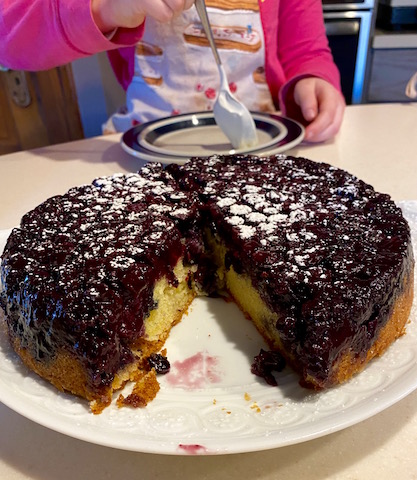


If there is a food that serves as a metaphor for our current lifestyle, it has to be a blueberry upside-down cake.  Seriously, hear me out.  Here is a vintage dessert that turns the idea of a cake literally on its head.  A cake where the unexpected substitution of blueberries for pineapple can become the new normal.   It proves that, “Hey, you can do this!”

Another upside-down aspect to this cake recipe is its provenance. I came across it a decade ago when I served as a judge for the James Beard Foundation’s annual cookbook awards.  Among the three dozen books they sent me to evaluate was Michelin chef Thomas Keller’s  ad hoc at home,  a volume of “family-style” recipes.  One of my duties was to test recipes from my three favorite books.  I chose Keller’s recipe for Pineapple Upside-down Cake, because it looked easy enough for a home cook with basic baking experience.  In his introductory notes to the recipe, Chef Keller suggests the possibility of substituting other fruits.  I can’t even take credit for that.

Why did I choose blueberries over other berries or fruits such a apples, pears or mangoes?  I admit my choice was a simple matter of timing.  An eighteen ounce container of Driscoll blueberries was on special the day I shopped at Whole Foods.  

In the last decade I’ve succumbed to purchasing Driscoll berries in the winter when locally grown berries are not available.  The Driscoll company is the oldest and largest purveyor of a seasonless supply of berries grown and shipped from all over the hemisphere. I can’t vouch for the sustainability of their agricultural or environmental practices.  That’s a subject for a future post once we get past our current trauma.
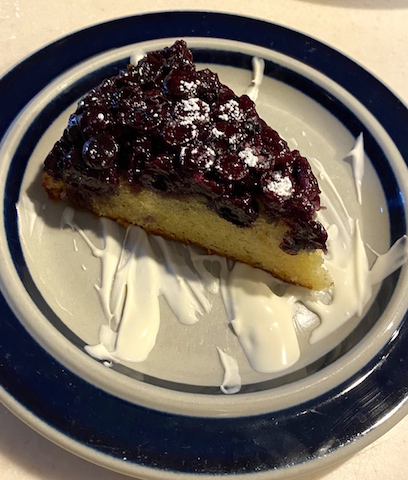


BLUEBERRY UPSIDE-DOWN CAKE 

Pan Schmear (enough for 2 recipes)

1 stick (4 oz) unsalted butter, at room temperature

1 1/2 tablespoons honey

1/2 teaspoon dark rum

1 cup, packed, light brown sugar

1/4 teaspoon vanilla paste or extract

Kosher salt

18 oz. fresh blueberries 

Cake

1 1/3 cup cake flour

2 teaspoons baking powder

1 stick (4 oz) unsalted butter, at room temperature

1/2 cup plus 2 tablespoons granulated sugar

1/2 teaspoon vanilla paste or extract

2 large eggs

1 tablespoon plus 1 teaspoon milk

Preheat the oven to 350 degrees.  Generously butter a 9” cake pan.  Line the bottom with parchment paper.  Butter the paper.  Set aside.

Combine the butter, honey, rum, sugar and vanilla in the workbowl of a mixer fitted with a paddle, and blend until smooth.  Spread 1/2 of the mixture over the parchment liner in the bottom of the pan.  Seal the remaining schmear in a jar or bag and refrigerate for a month or freeze for longer a longer period.  Lightly salt the schmear.

Rinse and pick over the blueberries.  Dry them by gently rolling in a towel.  Spread them evenly over the schmear.

Sift the flour and baking powder into a bowl.  Combine the butter and sugar in the workbowl of a mixer fitted with a paddle attachment, and mix over medium speed for 3 minutes, stopping twice to scrape down the sides of the bowl.  Mix in the vanilla, the eggs, one at a time and the milk stopping to scrape down the sides of the pan after each addition.  Add the flour mixture in 3 installments, scraping after each addition, and stir until just combined. 

Spread the batter over the berries, smoothing the top to completely cover them.  Bake for 45 -50 minutes, turning the pan after 15 minutes if you do not have convection baking.  The cake is done when a toothpick inserted in the center comes out dry.  A digital thermometer will read 200 degrees when inserted in the center..

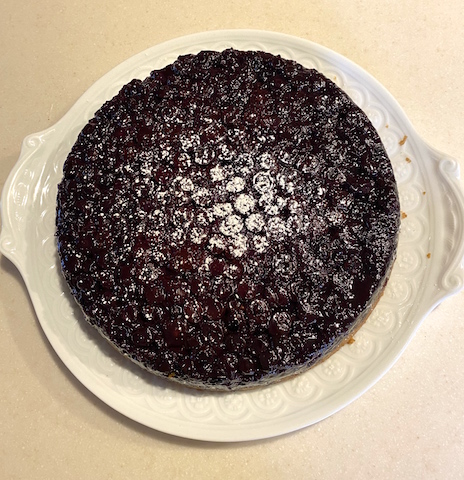
Remove the pan to a rack to cool for 20 -30 minutes.  Run a knife around the edge of the pan, place a serving plate on top of the pan and invert the cake onto the plate.  Remove the parchment if it sticks to the fruit.

Serve warm or at room temperature with crème fraîche 

Recipe adapted from ad hoc at home by Thomas Keller.
  • Written by Madelaine Bullwinkel

STAY-AT-HOME LEEK AND POTATO SOUP

The stay-at-home lifestyle has elevated dinnertime to high point of the day, if it wasn't already.  Say you have shopped just once a week during the last three weeks of confinement.  The makings of a simple, satisfying meal can be within reach.  It is as easy as returning to roots.  

You are forgiven for passing over root vegetables in the produce aisle.  They have zero eye appeal. What they lack in color and seasonality they make up for in the nutrients they have absorbed underground and fiber.  Roots are also loaded with starch which we break down into glucose.  Yes, eating root vegetables will give you a legal culinary high.

My favorite root recipe is a comforting soup of leeks and potatoes.   In France they call it Potage Parisien and treat it as if it were the little black dress of the culinary world.  First they swap out water for chicken broth and then proceed to dress it up with watercress, herbs or lettuce. 

I prefer to surprise guests by placing a thin slice of blue cheese in the bottom of the soup bowl.  The cheese is hidden, waiting to be discovered after the hot vegetable puree is poured over it.  A garnish of fresh chives adds the comforting green aroma of Spring.   

If you are not a fan of blue cheese, substitute another variety that melts easily, or grate a hard cheese into the bowl.  The point is to swirl the cheese into the soup as you consume it.  Each spoonful tastes a little different than the one before which accelerates the process.  You're soon ready for another helping. 


POTAGE PARISIEN (LEEK AND POTATO SOUP)

 Ingredients for 6 - 8 servings

4 tablespoons unsalted butter

3 cups thinly sliced leeks

4 cups peeled and cubed russet potatoes 

4 cups cool water

1 teaspoon kosher salt

freshly ground white pepper, to taste

1/2 cup whipping cream

3 ounces blue cheese

Garnish: 2 tablespoon minced fresh chives 

Melt the butter in a heavy 4 quart pot.  Cut the leeks 1” into the green portion.  Trim the root end and quarter the leeks lengthwise without separating them at the root end.  Rinse the interior of the leek leaves to remove any dirt.  Thinly slice and add them to the hot butter, stirring and cooking for 5 minutes as they soften.

Peel, quarter and cut the potatoes into 1” cubes.  Add them to the leeks and continue cooking for another 2 -3 minutes.  Pour in the water, bring the liquid to a boil and simmer, partially covered, for 15 minutes, or until the potatoes are tender.

Puree the soup with an immersion blender, season with salt and pepper.  Stir in the cream and thin with water, if desired.  Place a slice of cheese at the bottom of each soup bowl.  Pour on the soup.  Garnish with fresh chives, and serve immediately.


  • Written by Madelaine Bullwinkel

Claude Monet's Stay-At-Home Chocolate Gateau


With the expectation that two lonely weeks of social isolation would be our last, I got out a bottle of bubbly, some party hats, and my favorite chocolate cake recipe.  This plan was dashed yesterday when the President ordered a continuation of the school and business shut-down for an additional month.  Well, at least we can eat cake.

Before we get to dessert, I want to update my best practices notes on grocery shopping.  There are still no state or national guidelines to protect customers and staff in the stores.  Safeguards vary considerably from store to store.  I was ‘carded’ at Whole Foods during the hour reserved for seniors.  (Reminded me of the ‘good old days’.) I have heard Mariano’s offers shoppers gloves to wear, and Trader Joe’s limits the number of shoppers in the store at any one time.   I know for a fact that Jewel Osco has not made any changes, and I complained. 

Person to person contact remains the biggest risk factor for contracting coronavirus.  Whole Foods has made noticeable changes in this regard.  In addition to instituting a special shopping time for at-risk customers, check-out lanes in the store are staggered and  shoppers are physically separated in waiting lines by improvised barriers.  More importantly, a screen of clear plastic the size of a motorcycle windshield separates the check-out worker from the customer.  This is proactive.  The employee behind the register is both exposed and the potential source of exposure to everyone in her line all day.  Grocery workers are beginning to complain.  My advice is to wear a mask if you have one and a pair of gloves when shopping


ChezM subscriber Jeff Abell sent me the link to a YouTube video entitled What did Claude Monet Eat in a Day?    He remembered my class at the Alliance Française in 2012 that featured recipes from Monet’s cooking notebook.  The chocolate cake we made that day has since become a favorite for us both. 

In true 19th century fashion, this gateau has only five ingredients.  Dark chocolate and butter are the major players followed by eggs and sugar, and there’s just a little flour added into the mix.  The resulting cake has the impact of a dark chocolate candy bar with the mouthfeel of a soufflé.

I have taken the liberty of doubling the recipe to accommodate 21st century dessert expectations.  The cake may fall a bit as it cools.  You can fill the center with whipped cream if it bothers you.

CHOCOLATE GATEAU

Ingredients for 8 to 10 servings:

4 ounces semisweet chocolate 

1/4 cup water

8 tablespoons (one stick) unsalted butter

4 large eggs at room temperature, separated

1 cup confectioners’ sugar

1/4 cup flour

Preheat the oven to 325 degrees.  Generously butter a 8” cake pan.  Line the bottom with parchment and butter it.

 Break up the chocolate bar into a glass bowl, add the water and microwave on full power for one minute.  Remove the bowl and stir until the mixture is smooth.  Whisk in the butter, one tablespoon at a time, until smooth.

Beat the egg yolks until they ribbon using an electric mixer.  Stir in the chocolate mixture, then sift on the sugar and flour and blend them in carefully.  Beat the egg whites to firm peaks and fold them into the batter in 3 installments.  Carefully pour the mixture into the prepared pan and bake for 30 - 40 minutes.  The fully baked cake will be firm in the center and begin to pull away from the sides of the pan.  A digital thermometer inserted in the center will register 200 degrees.  

Let the cake cool on a rack for 15 minutes.  Run a knife around the edge of the pan, and unmold onto a serving platter to cool completely.  Dust with confectioner's sugar before serving.