A+ A A-
  • Written by Madelaine Bullwinkel

AN AMERICAN HARVEST GRATIN
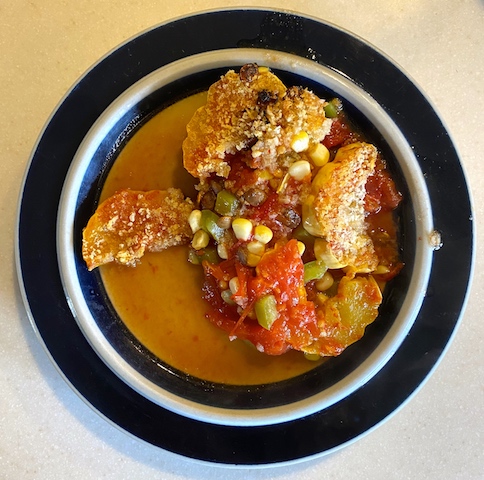
This is the moment when cooks can feel closest to nature.  The bounty of freshly picked fruits and vegetables are piled high on tables at urban farmers market tables and rural farm stands. Some of us are harvesting from plants in our own backyard.  Cooking ingredients only hours out of the ground makes for the best eating.   It’s a difficult goal in our distracted lives, but worth the effort to try.

Few farmers markets specialize in sustainably raised and organic produce.  For the past fifty years  American agriculture has favored large corporate farms that serve as laundries for the federal government and the agrochemical industry.   Organic farms account for less than half a percent of total acreage today, although many of them grow foods that form the basis of our diet. It's worth seeking them out for the added nutritional value and flavor they contain.
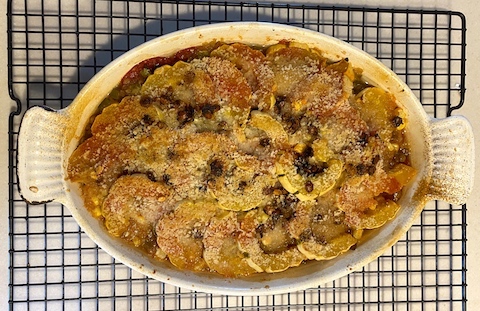

My persistent search for the taste of what grows naturally in America defaults to plants native to the western hemisphere: corn, peppers, squash and tomatoes.  Native, in this case, is not the same as local.  These crops were originally cultivated by the indigenous people of Mexico and Central America.  Spanish explorers took them home as trophies, and a century later European settlers brought them to North America.  Never mind, we embrace them as our own.

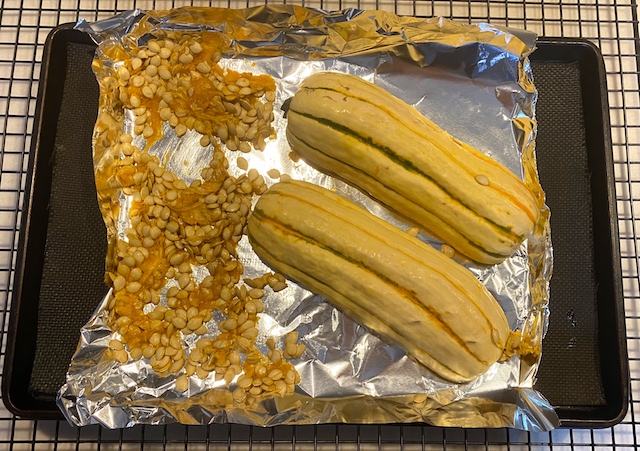
The specific inspiration for this Harvest Gratin was a cylindrical, cream-colored squash, scored with thin green and orange stripes.  The arrival of the DELICATA is often overlooked among its larger, more flamboyant hard shell cousins.  To me it's a sign of fall as surely as the first robin heralds Spring's arrival.  It’s thin shell makes it easier to work with than most winter squash.  I wash it but never peel it.  And you don’t have to take my word alone.  On more than one occasion the delicata was my cooking students' favorite in taste-tests with acorn, butternut, buttercup, turban and spaghetti squash.
This gratin is tests the old adage: ‘plants that grow together, go together’.  How much affinity will these ingredients that originated in the wilds of Central America have for one another?  How does that work, and does it matter as long as its delicious?  You can decide for yourself, and enjoy!

AN AMERICAN HARVEST GRATIN: DELICATA SQUASH, TOMATOES, PEPPERS AND CORN
Ingredients:
1 pound delicata squash
1 tablespoon salad oil
1 pound fresh tomatoes, cored and thinly sliced
1 cup green bell pepper, diced
Kernels from 1 large ear of corn
2/3 cup homemade Tomato Sauce*
Kosher salt
1/2 cup fine Panko crumbs
1 tablespoon nut or vegetable oil
1 teaspoon smoked Spanish paprika

Preheat the oven to 350 degrees.  Line a baking pan with aluminum foil.

Squash: Halve the squash and scrape the seeds out into a strainer.  Place the squash halves cut side down on the foil.  Rinse the seeds free of their fiber and pat them dry.  Toss them with 1 teaspoon of oil and spread them out around the squash halves on the foil.  Bake for 30 minutes.
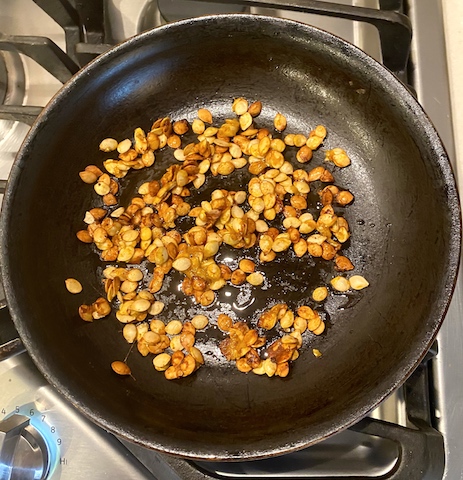
Remove and turn over the squash halves.  When cool enough to handle, cut them in to 1/2” slices.  Toast the seeds in 1 teaspoon of oil over medium heat until they are deep brown.

Assembly: Oil a 1 1/2 quart baking dish with the remaining teaspoon of oil.  Make a layer with half of the tomato slices.  Lightly salt.  Follow with 1/2 of the diced peppers and 1/2 the corn kernels.  Scatter on 1/3 of the toasted squash seeds and the slices of one the squash halves. Lightly  salt again.  Drizzle on 1/3 cup of Tomato Sauce.  Repeat this layering ending with the squash seeds and a light coating of Panko crumbs.  Cover the dish and bake for 45 minutes in the 350 oven.

Finish:  Remove the dish and lift off the foil.  Drizzle on a remaining tablespoon of nut or vegetable oil.  Return to the oven and turn the oven to 400 degrees.  Bake for 15 - 20 minutes or until top is browned.  Dust with paprika before serving.
  • Written by Madelaine Bullwinkel

REDISCOVERED RECIPES: JACKIE SHEN'S CRAB CAKES AND JALAPENO CREMA

Blog reader Bonnie Rabert wrote to thank me for posting a steady stream of recipes during the recent lockdown.  They inspired her to sort through the favorites she compiled during career as a food stylist in Chicago.  I asked if she would send me a few to share with my readers, and she did.

Among Bonnie’s “rediscovered” recipes was one that teased my memory.  It was a Crab Cakes with Jalapeño Crema from chef Jackie Shen, a name from the past that I couldn’t quite place. Thanks to Google, I did not have to agonize very long.

Jackie Shen came to the States from Hong Kong to study at the age of eighteen and rose to celebrity status on the Chicago food scene in the 90’s.  Her namesake restaurant in Lincoln Park introduced the city to French/Asian fusion cuisine.  Her best known creation, however, was a dessert, the chocolate bag, made by painting the inside of a popcorn bag with dark chocolate.  The bag was filled with white chocolate mousse and garnished with fresh berries.  When asked, Jackie claimed the idea came to her after watching a Julia Child program.

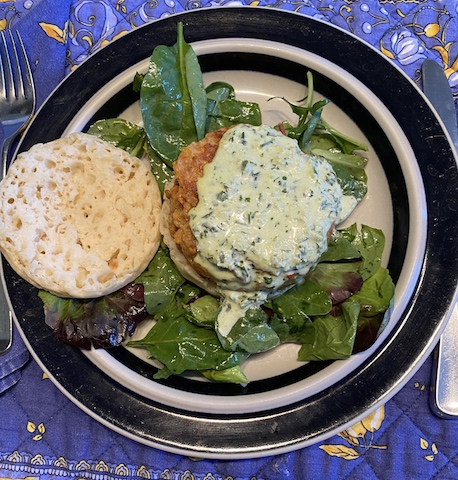
Jackie’s crab cakes and their crema turned out to be as delicious a combination as I’d hoped.  I used half lump crabmeat and half backfin to keep costs down.  The results were just as successful when I substituted a pound of canned wild salmon for crab My modifications to the recipe were minor.  I dissolved the dry mustard in a tablespoon of water before adding it to allow its flavor to develop.  I also replaced breadcrumbs with Panko.  By the way, the jalapeño crema makes an excellent base for salad dressing and a condiment spread on sandwiches.  That is, if there is any left over.

In 2012 Jackie ‘retired’ to New Buffalo, MI where she has opened Jackie’s Cafe for breakfast and lunch.  Thanks to Bonnie, I’ve rediscovered Jackie and am curious to know how her new career running a place where the locals can gather.  She’s one of those remarkable cooks whose cuisine makes you want to move next door.   Anyone up for a field trip to New Buffalo? 


CHEF JACKIE SHEN'S CRAB CAKES

2 eggs, beaten

¾ cup mayonnaise

½ teaspoon finely chopped garlic

½ teaspoon dry mustard

½ teaspoon cayenne

1 pound lump crabmeat, drained, sprinkled with lemon juice and broken into small pieces

¼ cup finely diced red pepper

¼ cup finely diced yellow pepper

2 green onions, white and light green, finely chopped

¾ to 1 cup dry bread crumbs 

Mix eggs and mayonnaise together in a bowl; add garlic, mustard and cayenne.  Add crabmeat, peppers and green onion.  Add ¾ cup dry bread crumbs to crab mixture.  If too moist, add more bread crumbs. Use a #40 scoop to portion mixture into a ring to shape.  Cover and refrigerate.  To cook, brown in a little olive oil over medium heat, turning to brown on both sides.  Finish in a 350 degree oven for 5 to 10 minutes.  Makes 12. 

Source: Chef Jackie Shen. First prepared in 1996


JALAPENO CREMA

1 small clove garlic, peeled, halved and any core removed

1 large jalapeno pepper, seeded, coarsely chopped

¼ cup fresh parsley leaves

½ cup fresh cilantro leaves

¼ cup extra virgin olive oil

2 tablespoons white vinegar

½ teaspoon salt

¼ cup sour cream

2 tablespoons mayonnaise 

In a blender, with motor running, drop garlic through opening in lid to chop finely. Repeat with the jalapeno.  Add parsley, cilantro, oil, vinegar and salt.  Cover and blend until smooth. In a bowl, combine sour cream and mayonnaise.  Whisk in jalapeno mixture until fully incorporated. Cover and chill to blend flavors. Makes 1 cup.

  • Written by Madelaine Bullwinkel

HIDDEN TREASURE: STEWED RADISHES

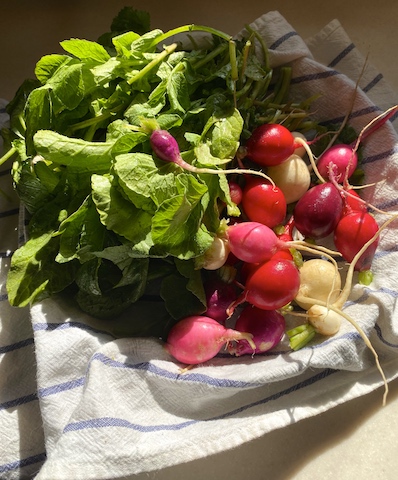
One of my favorite vegetable families is invisible to anyone taking a casual stroll in the garden.  Members grow enlarged, underground roots that gather a wealth of nutrients from the soil and turn amazing colors.  I eagerly reach for maroon carrots, yellow beets and purple potatoes when they appear in the market.  My most recent fetish has been for the little round ball the size of a shooter marble dressed in Easter egg colors.  The radish bears the Greek name for the entire family, radix.


Radishes are a nutritional powerhouse largely overlooked in American cooking.  Red radishes appear in a crudités basket at the cocktail hour where their signature hot, mustard flavor and crunchy texture provide a refreshing break between sips.   Even in an unpretentious role as a canapé, its black cousin  can inspire awe when served on a thickly buttered slice of country bread with a sprinkle of truffle salt.  But I digress.


Meanwhile above ground, radish greens offer a rich array of antioxidants as well as Vitamin C and Calcium.  Rather than throw them out, the French turn this humble green into substantial soup enriched with chicken stock, potatoes and cream.  In summer I prefer to cultivate the mild mustard taste of radish greens wilted with sauteed red onion and green pepper from the garden.


A  recipe for stewed radishes as a stand-alone vegetable is a rare find, but Jacques Pepin offers a quick technique that preserves the radish’s agreeable crunch and color while it reduces its heat.  This recipe takes less than five minutes cook, and combines steaming with stewing to produce a perfect al dente texture.

Not every bunch of supermarket bunch of radishes meets the freshness test for this recipe.  They may be a produce staple, but they are surprisingly sensitive to handling.  Avoid roots that have developed cracks and greens that show signs of wilting. Separate roots from greens once you get them home.  The greens in particular require rinsing in several changes of cold water to remove dirt or grit hiding among the stems.  I spin and towel them dry and prepare them in the next two days before the leaves lose their bright, green color and firmness.

Stewed 'Easter Egg' radishes (or red ones) and their greens make an attractive and unexpected side dish with grilled meat or fish.  In my next blog, this radish stew will garnish Crab Cakes served with a Jalapeño Cream Sauce.  Stay tuned.


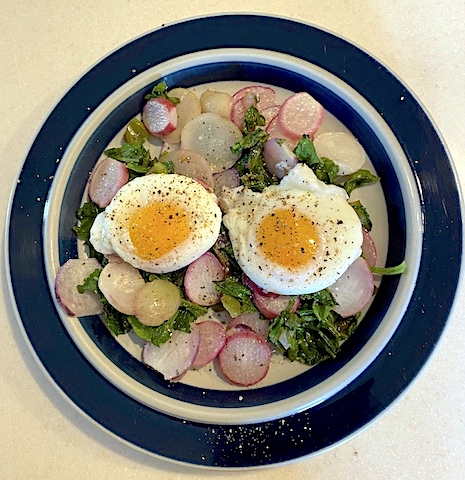
STEWED ‘EASTER EGG’ RADISHES WITH POACHED EGGS


Ingredients for 4 servings:


2 bunches ‘Easter Egg’ or Red radishes
1 tablespoon walnut, other nut oil or olive oil
2 tablespoons unsalted butter, divided
1 tablespoon water
1/8 teaspoon salt
1/3 cup diced red onion
1/3 cup diced green pepper
Greens from 2 bunches radishes, cut into 1” long strips
2 tablespoon vegetable broth or water
Salt and ground pepper, to taste
8 large eggs
Smoked Spanish paprika (optional)


Radishes:  Trim off stem ends and tails from the radishes and slice slice them 3/4” thick.  Bring oil, butter and water to a simmer with salt in a large skillet.  Stir in the radish slices, cover the pan and cook for 2 minutes.  Uncover and continue cooking until the moisture has evaporated, another 3 minutes or so.  The radishes should be just tender.  Use a flat sieve to remove the radishes into a bowl and set aside.


Greens:  Melt the remaining tablespoon of butter in the skillet.  Sauté the onion and pepper pieces over medium heat until the onions soften.  Add in the radish green slices, broth or water and cover the pan for 2-3 minutes to wilt them.  Uncover the skillet and stir in the sliced radishes.  Cook another minute to evaporate any remaining liquid.  Season with salt and pepper.  Distribute the radishes on 4 plates.


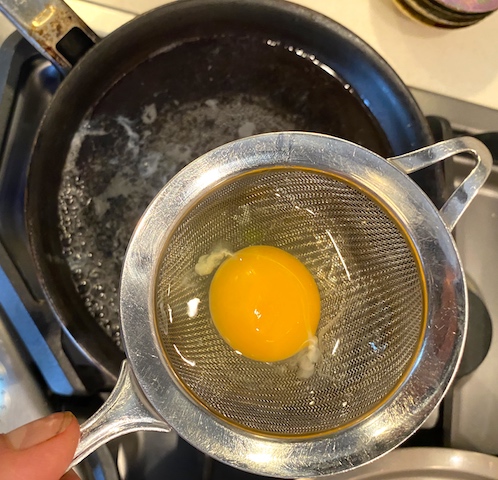
Eggs:  While radishes are cooking, bring a quart of water to a boil.  Rinse out the skillet and pour in enough water to come 2” up the side of the pan.   Break each egg into a small strainer over a bowl and let the loose albumen drain out.  Turn out each strained egg into the simmering water, and cook until the egg yolks are just set, about 3 minutes.  Lift out each egg with the flat sieve, and distribute two to a plate on the radishes.  Season with salt, pepper and optional paprika.  Serve immediately with sliced baguette or English muffins.