A+ A A-
  • Written by Madelaine Bullwinkel

QUICKEST EVER STRAWBERRY JAM

Strawberry jam is as American as apple pie with a special benefit other comfort foods lack. A fruit preserve can be enjoyed over an extended period of time. In the process of preserving fruit, its juices concentrate and flavor intensifies for later enjoyment. So, why rush to make it quickly?

Let’s look at preserving from the strawberry’s point of view. Like all fruits, the strawberry desires to be eaten raw, digested and its seeds expelled on the ground to produce the next generation. Modern indoor plumbing and commercial agriculture have messed once again with Nature’s plan to an alarming extent. Instead of foraging for scarlet berries half-hidden under trefoil leaves in the forest, we purchase clamshells of plumb, hybridized, often imported, berries in the supermarkets. Never mind. Berries are presently inexpensive and tasty eaten directly out of their plastic clamshell packaging.
The best way I have found to preserve the flavor in a food designed to be eaten uncooked is to work in small batches and quickly.  I said as much thirty-five years ago in the first edition of Gourmet Preserves Chez Madelaine. That did not rule out the inclusion of more time consuming techniques. In 1983 my point of departure was the first historic reference to eating fruit preserves found in Boccaccio’s 14th century Decameron Tales. It's most ironic that this book from the Renaissance was set a secluded estate inhabited by Florentine aristocrats during the Black Death pandemic.

Today’s pandemic requires an updated solution. The time-honored process of making preserves with whole berries steeped in concentrated juices is less appealing than the fresh, less-sweet flavor of minimally processed fruit. In the ensuing decades, I have also discovered that the nuanced flavors of jams and preserves decreases over three to six months time. It is yet another reason to make small batches of jam.
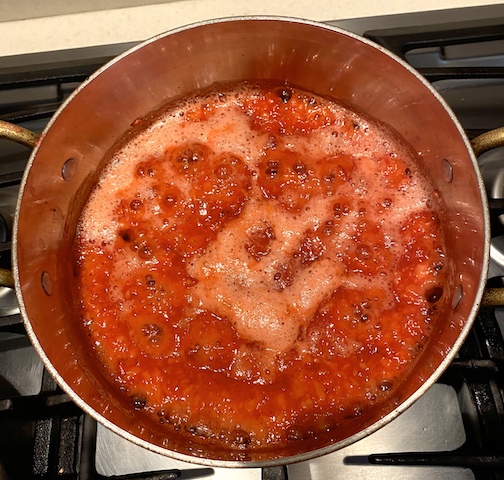
This recipe makes about one cup of jam. It’s just the right size to pour into a glass jar and store in the refrigerator. It will keep for a month easily, if you haven’t eaten it all by then. You can double the recipe and make enough eight ounce jars to share with neighbors and friends using directions for processing and sealing jars in the current version of my book, Artisanal Preserves.
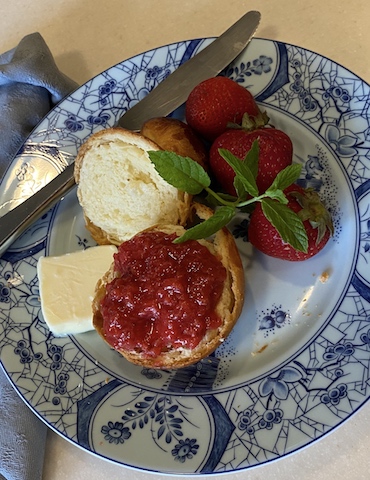
QUICKEST EVER STRAWBERRY JAM

Ingredients:

1 pound ripe strawberries

1/4 cup + granulated sugar

1 + tablespoon freshly squeezed lemon juice

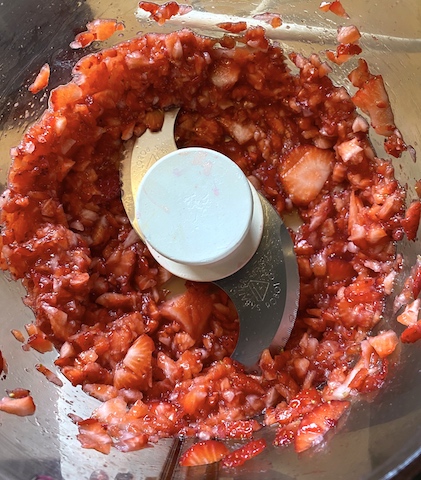
Rinse the berries well.  Trim off the green leaf portion, halve each berry and place in the work bowl of a food processor or blender.  Use the pulse function to finely dice the berries.  You can also chop them by hand into pieces the size of a pea.  Transfer the berry pieces to a 2 quart pan.  Thoroughly stir in 1/4 cup sugar, cover the pan and let the mixture stand for 20 - 30 minutes. 

Bring the berries to a simmer over medium high heat and cook, stirring often for 5 minutes or until there is almost no residual liquid in the bottom of the pan and the berry pieces are still discernible.  Add the lemon juice and cook another 30 seconds.

Off the heat, cool down a 1/2 teaspoon of the jam and taste to determine the balance of sweet and sour.  Add more lemon juice or sugar as needed and cook another minute or two.  

Pour the hot jam into a 12 ounce glass jar, lightly cover with plastic or the jar lid, and let the jam cool on a rack.  Screw cap on tightly and refrigerate.


  • Written by Madelaine Bullwinkel

FIG CLAFOUTIS

Even a diner accustomed to reading menus in French will reach for their copy of LaRousse when fig clafoutis appears on a dessert list. There’s no shame in that. The clafoutis, a spinoff of the rustic Limousin flognard, hasn't been popular in restaurants for more than a century. Like most site-specific dishes, this crustless custard baked in a shallow tart mold was designed to showcase a tiny, heart-shaped cherry, coeur de pigeon (pigeon heart).  This rustic dish studded with unpitted cherries evolved into a fashionable fruit-filled pudding with an Occitan name in the 19th century.

The first tours I led to France in the 1990’s took us into the Limousin heartland with its rolling hills of orchards, grazing animals and ancient forests. We prepared our first flognard with raspberries in the spacious kitchen at Chateau de Sannat where we lived an idyllic life and cooked with provisions from the central market in Limoges. Every summer tour since then has included this simple dessert with whatever fruit was ripest at that moment.

These pleasures were far from my thoughts last week as I entered my local supermarket at 7 am wearing face mask and gloves. Suddenly, there they were in the display case: a carton full of ripe figs. One look at those plump, beauties brought back memories of serving roasted whole figs on a goat cheese salad in our Paris apartment, sautéing figs to garnish duck breast in a Luberon vineyard setting and, yes, baking fig clafoutis in Uzes.

A clafoutis made with figs has great eye appeal and harbors a fascinating story of plant and insect coevolution. The fig fruit's petals are on the inside and serve as a nesting place for designated fig wasp eggs the contents of which hatch, pollinate the fig’s seeds and depart through the furry-looking passage in its base. I couldn’t make up a story this amazing.  For those who worry about eating the remains of male fig wasps, the fruit produces a natural enzyme, ficain, which dissolves them before they arrive in our kitchens.

Assembling a fig clafoutis takes about as long as it takes for your oven to reach 400 degrees. The custard is the consistency of a crêpe batter which has a similar composition.  I make it first and let it rest while preparing the fruit.  You may want to substitute a flavored liquor or fruit brandy that matches the stone fruit or berry you are using.  Clafoutis are also wonderful in winter filled with pears or apples. Enjoy!

FIG CLAFOUTI

Ingredients for 8 servings:

9 12 fresh figs

2 tablespoons sugar

2 tablespoons Port

Custard:

2 teaspoons each unsalted butter and sugar (for the mold)

3 large eggs at room temperature

3/4 cup sugar

6 tablespoons unbleached flour, sifted

1 1/2 cups milk

Preheat the oven to 400 degrees.  Generously butter and sugar a 1-1/2 quart baking dish.

Blend the eggs in an electric mixer until frothy.  Gradually add the sugar, flour and milk.  Mix well, for 2 minutes.  Let this batter rest while preparing the figs.

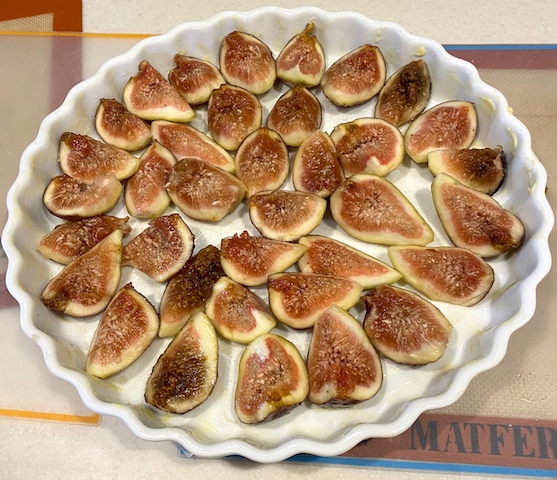
Trim off  tough stem end of the figs, quarter each and place in a bowl.  Sprinkle fruit with sugar and Port.  Toss occasionally while assembling the other ingredients.

Distribute the fig pieces evenly over the bottom of the baking dish. Spoon the batter over the fruit.  If you have extra batter,  add it after the pudding has been in the oven for 10 minutes.

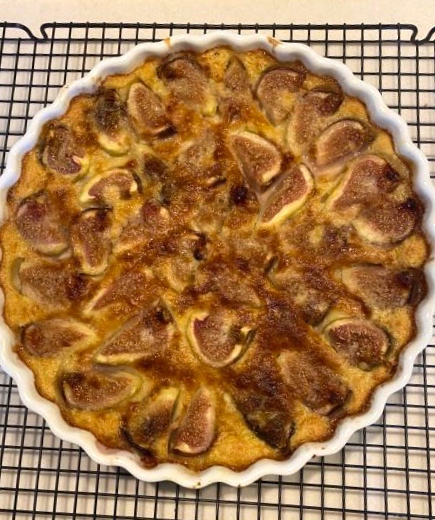
Bake for 30 minutes or until the custard is set and lightly browned.  Cool on a rack.  Serve warm or at room temperature.


  • Written by Madelaine Bullwinkel

DECONSTRUCTED TABOULEH SALAD

Summer fruits and vegetables bring out the artist in every cook.  Nature provides these ingredients in a palette of colors, shapes and textures with which a cook can conjure a edible still life on a plate. After all, we all eat first with our eyes.

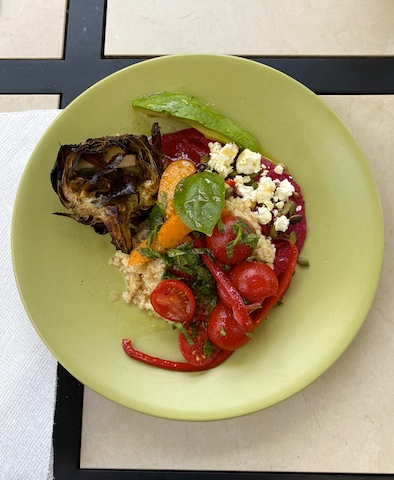
This year, the plate that Chef Suzanne Florek set before me at the lunch we share to celebrate our June birthdays was over the top.  It looked too beautiful to eat.  (Appetite won out over aesthetics in the end.)

When I asked Suzanne for the recipe to accompany my photo for his blog, she sent a list of ingredients rather than a recipe, per se.  Her combination of a beet mash, tabouleh and fruit salad was a one-off of elements she will modify to suit her mood the next time she makes it.   That ability to improvise is worth cultivating, and summer offers many opportunities for us to express ourselves as cooks.

Suzanne’s cooked bulgar wheat was unadorned in the truly deconstructed sense of the word.  She wrote that she will soak it next time.  I took her cue and soaked it, a move that preserves the rough texture of the wheat, and added chopped tomatoes, mint,  parsley and olive oil.  The beet mash adds brilliant drama to the plate and an earthy flavor with a tart, and yogurt finish.   I used what I had on hand for the salad with an eye to including several colors and a fresh, green leaf or two.

The only element of the plate I could not pull off was the grilled artichoke quarter which I attempted indoors using a Le Creuset grill pan.   If you want to try it outdoors, be sure to generously oil the cut sides of the artichoke, and scoop out the fuzzy choke portion before serving.

I would love to see your deconstructed summer salads.  Please take a photo beforehand and send them to me with your ingredients.


DECONSTRUCTED TABBOULEH WITH BEET AND SWEET POTATO MASH, SIDE SALAD AND FETA CHEESE

MASH
2 1/2  cups beets (1 lbs) cooked
1 cup cooked sweet potatoes
2 cloves grilled garlic
1/2 teaspoon fennel seed, toasted
1/2 teaspoon coriander seed, toasted
1 carton (5.3 oz) Skyr yogurt (Siggi’s)
1 tablespoon freshly squeezed lemon juice
1/2 teaspoon kosher salt
Freshly ground black pepper, to taste


TABBOULEH
1 cup cracked wheat
1 cup boiling water
1 tablespoon olive oil
1 teaspoon fresh mint, minced
1 teaspoon fresh cilantro or parsley, minced
1 small tomato, diced
1/2 teaspoon kosher salt
Freshly ground black pepper


VINAIGRETTE
1 tablespoon Sherry vinegar
3 tablespoons olive oil
Salt and pepper to taste

SALAD
4 cups fresh green
1 ripe apricot
1 tomato or 6 cherry tomatoes
2+ tablespoons feta cheese

8 slices grilled sourdough or baguette slices

MASH:  Bake beets and sweet potato in a 400 degree oven.  Trim, rinse, dry and wrap beets in foil.  Pierce sweet potato twice.  Sweet potato will cook in 30 minutes; beets will take an hour.  Let the vegetables cool, peel, cut them.  Reserve.

Toast the garlic cloves, unpeeled, in a dry skillet until they are fragrant and soft.  Remove, add fennel and coriander seeds and toast, shaking the pan occasionally until they start to color and become fragrant.  Crush the seeds in a mortar and pestle or process them for 1 minute in the food processor before adding the vegetables.  Pulse a dozen times, then run the processor until the mash is smooth.  Add the yogurt and lemon juice and continue mixing another 15 seconds.  Pulse in salt and pepper to taste.  Reserve.


TABBOULEH: Add boiling water to the tabbouleh and allow to stand as directed on the package.  Place grain in a towel or cheese cloth and twist out residual water.  Turn the bulgar into a bowl and add the herbs, tomatoes and olive oil. Toss well and season to taste with salt and pepper.

SALAD: Mix the vinaigrette in a jar with a cover or whisk in a bowl.  Toss the salad greens with 3/4 of the dressing.  Toss the tomatoes and apricot combo with the rest.

ASSEMBLY:  Spoon on the Beet and Sweet Potato Mash on one side of the place in the shape of a large comma.  Nest the greens in the center of the plate.  Mound a portion of the tabouleh facing the comma.  Top the greens with the vegetables and spread the crumbled or sliced feta over the mash.  Serve with grilled bread.