A+ A A-
  • Written by Madelaine Bullwinkel

MY PERSIMMON HABIT


Just thinking about what life has been like this past year makes you want to stick your hand in a bag of chips or open a bar of dark chocolate  Snacking may be the quickest source of pleasure during a pandemic, but for those in the habit of delaying rewards, I recommend playing the long game.  Rather than giving in to the easy comfort traps, I’ve developed a craving for a weird, shape-shifting fruit that looks like a tiny pumpkin, tastes a like a date and seduces the mouth with the consistency of custard. Yep, it’s the persimmon.

Persimmons are at the top of my grocery list from November through February, months when one or more varieties appear in our markets. It’s a mystery to me why this iconic fruit that’s been revered in Asia for 2,000 years is just now appearing in  the States.  Let me begin by introducing the ones you’re most likely to see at the supermarket.

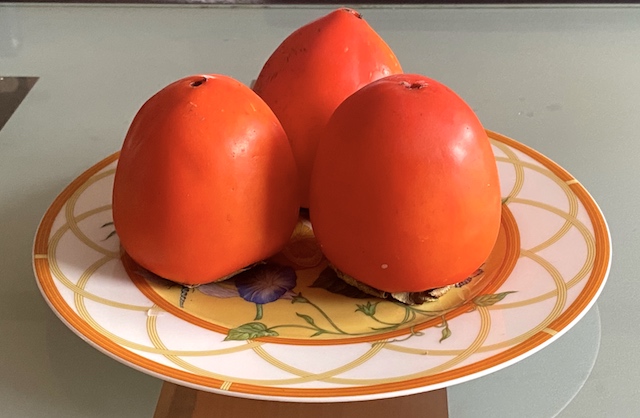
The squat, pincushion-shaped fuyu persimmon is the national fruit in Japan where it is called a kaki and eaten dried.  Drying persimmons concentrates its sweetness while offering substantial amounts of A and C vitamins, the minerals manganese, potassium as well as fiber.  The hachiya persimmon is even more likely to draw your attention in the store. Its gleaming orange surface invites the hand to caress a shape reminiscent of a TV Conehead.  Unlike the fuyu, hachiya's natural tannins do not dissipate until it is very ripe.  Eating one short of that state will pucker your mouth and make your teeth itch. 

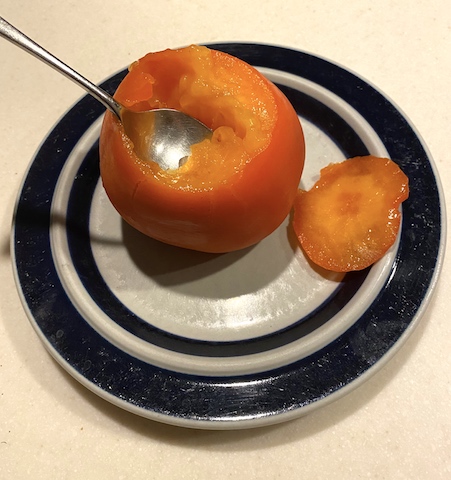
Both varieties ripen within the week on a kitchen counter.  If you are in a hurry, seal them in a paper bag with a banana for a day or two.  The ripe Hachiya develops a most amazing, jelly-like texture when frozen and then defrosted in the refrigerator. Try this technique if you are looking for a machine-free sorbet,  You can even store these persimmons in the freezer for days.
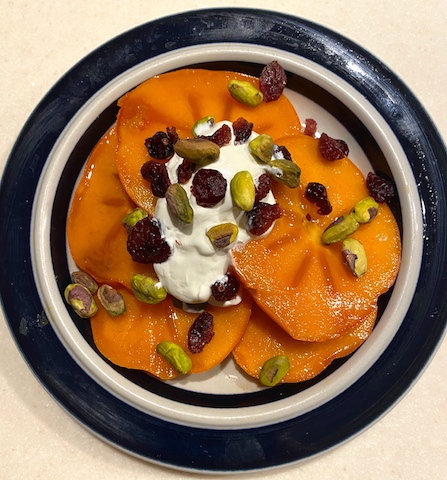
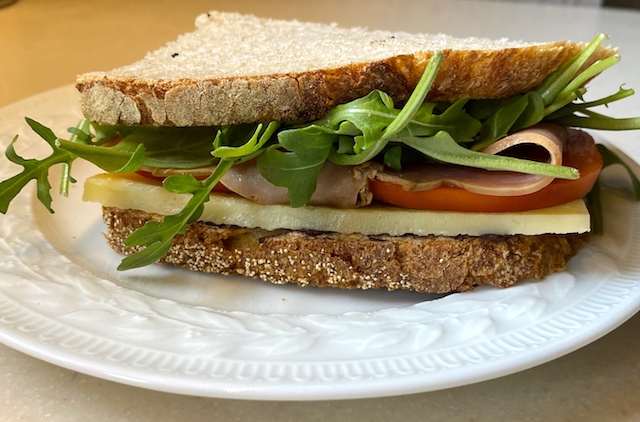
The fuyu persimmon looks so much like a small tomato that I find myself using it  as if it were one in sandwiches with ham and cheese or simply grilled with brie.  The fuyu also slips into the traditional role in a fruit in salad or featured in a dessert with a dollop of yogurt and a sprinkling of dried cranberries and pistachios.  I have been hesitant to add persimmons to coffee cakes and jams for fear that its unique sweetness and soft texture will be lost in the process. That said,  my one experience baking a Persimmon Membrillo Galette turned out to be very successful.  The recipe features concentric rings of persimmon slices on a bed of membrillo (quince paste) curd baked in a buttery pastry shell.  The persimmon slices roast to succulent perfection in the oven.
To this glowing fruit review, I add one caveat: do not snack on either persimmon if you have an empty stomach.  An acid in the underripe hachiya persimmon's tannins  can create a hairball in the human intestines.  I have good news too!  The acid that can causes this problem has been bred out of new persimmon varieties.  I just found one called a Sharon Fruit at my local market this week.
  • Written by Madelaine Bullwinkel

KHICHDI: COMFORT FOOD FROM INDIA

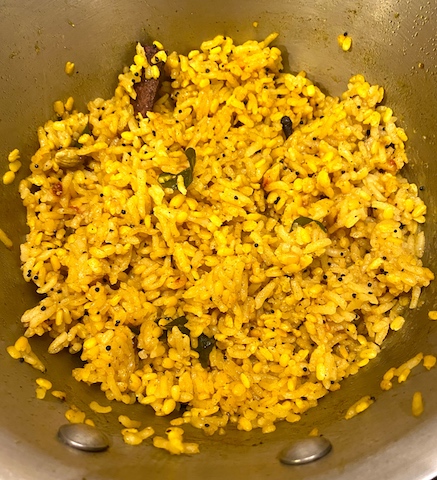
The warmth emanating from the golden rice called Khichdi caught my eye when it appeared recently in the Food Guide from The New York Times.    The seasonings in the recipe that accompanied the photo featured a  balance of sweet cinnamon, cooling cloves and hot chile powder that promised to enliven any number of winter meals.  The addition of moong dal (split mung beans) to long grain rice would create a soft, custardy texture.  In short, I was hooked on Khichdi before I even prepared it.


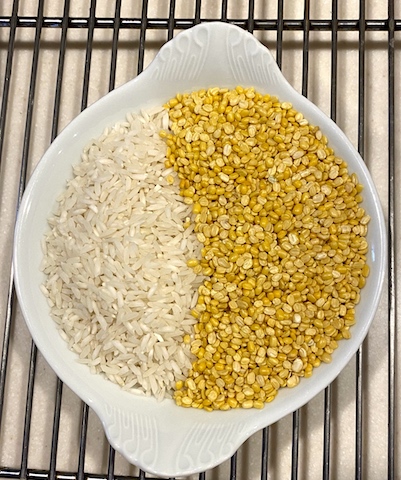
An Asian rice recipe always presents westerners with a teachable moment.  We are unprepared to soak rice for 15 minutes before heating it, although this practice halves the cooking time.  The wait is more than worth it.  Soaking rice removes its phytic acid and improves the body’s absorption of its iron, zinc and calcium.

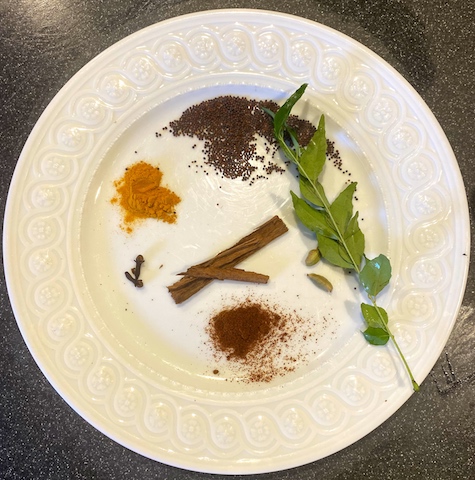
If you are new to Indian cooking some of the spices in a Khichdi  may require a trip to the supermarket.  Cinnamon stick, cloves, cardamom pods and mustard seeds are whole spices that will keep more than a year.   They are staples of Asian cooking.  Curry leaves are an optional ingredient and an intriguing one. Their pungent scent is one I associate with warm, wet soil and citrus.  They are leaves from a tree, not to be confused with curry powder which is a mixture of spices.  Small bundled stems of curry leaves are available in the refrigerated section of Indian grocery stores.  Indian medicine attributes numerous nutritional and health benefits to them eaten fresh or cooked.  They will keep for two weeks refrigerated.  Substitutes to curry leaves in Khichdi include a bay leaf added directly to the cooking rice and freshly slivered basil leaves folded in just before serving.

Then there is ghee, a concentrated form of butter that Indian cooks use for frying.  It is available in the international aisle of most supermarkets.  You can make this clarified butter at home by simmering butter slowly to evaporate its water content, skimming off the casein foam from the surface, then spooning off the golden butter fat from the milk solids that will brown and stick to the bottom of the pan.   A easier solution is to substitute vegetable or grape seed oil to fry the spices and fold in a tablespoon or two of butter after the rice is cooked.


A container of Khichdi hwa become a frequent resident in my refrigerator.   Why am I addicted to the explosive scent of spices when they hit the rice water or the golden hue of turmeric?   It didn’t take much research to find that Khichdi is the choice of Indian mothers when they introduce their babies to solid food.  I have succumbed to a comfort food from the other side of the world.


KHICHDI


Ingredients:


2/3 cup long-grain white rice (jasmine or basmati)
1/3 cup yellow split moong beans
2 tablespoons ghee or vegetable oil
1/2 tablespoon mustard seeds
1 cinnamon stick
2 green cardamom pods
2 whole cloves
1/4 teaspoon red chile powder
1/4 teaspoon turmeric powder
1 sprig curry leaves or 1 bay leaf added to the rice
1/2 teaspoon kosher salt, or to taste
1 dozen fresh basil leaves, rolled together and thinly sliced, to replace curry leaves


Begin by soaking the rice and moong dal for 15 minutes in 4” cool water.  Drain and place the rice and dal in a pan with 1 3/4 cups cool water.  Cover and bring to a boil over medium heat.


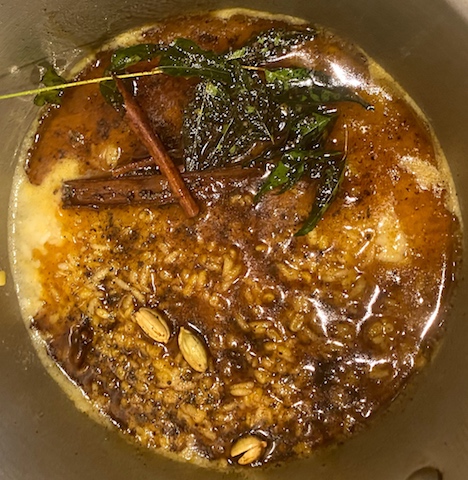
Heat the ghee or oil in a small skillet with the mustard seeds.  When the seeds begin to pop, add the cinnamon stick, cardamom pods, cloves, chili powder, turmeric and curry leaves.  Let them cook in the hot oil for a minute swirling the pan to coat them, then add them to the rice, off the heat, taking care to avoid the splatter created when the hot fat hits the water.


When the liquid in the saucepan comes to a boil, give the contents a thorough stir to mix in the spices and add the bay leaf if you haven’t added the curry leaves.  Turn down the heat to a simmer, cover the pan and cook for 15 minutes.  Off the heat, let the rice stand for 10 minutes.  Remove the spices that are visible on the surface, and stir in the basil strands if you haven’t added curry leaves.  Season to taste with salt.


This recipe's author Tejal Rao suggests serving Khichdi with a garnish of cilantro leaves, some whole milk yogurt and a jarred Indian lime-pickle.  I have served it as a stuffing in baked delicata squash, with grilled fish and tossed with sauteed Tuscan kale.


In

  • Written by Madelaine Bullwinkel

GOAT CHEESE GNOCCHI

If you ever wanted to make pasta by hand but were too afraid to try, let me introduce you to gnocchi.  It’s a pillow-shaped pasta that the most timid cook can make without having to resort to a YouTube video.  The first step is to examine how different it is from flat pasta noodles.

The pasta we now buy dried and boxed was originally the preserve of live-in Italian nonnas who spent their waking hours mixing and rolling out dough with a slender tapered rolling pin.  These grandmothers knew how to wield this pin, modifying the pressure with each pass to create an impossibly thin sheet of dough which they then casually folded like a freshly laundered sheet and cut it into thin strips.  I’ve watched this process, and it is amazing.

Less well known is the dumpling-shaped pasta known as gnocchi.  Mashed potatoes replace much of the flour in this dough making it firm enough to roll into logs like cookie dough and cut into into individual pieces.  The soft malleable gnocchi can take on any number of shapes from round, to oblong, to furrowed and stamped.   You can purchase a wooden board to imprint the pasta if you don't have a nonna handy.

Today’s featured recipe is yet another, easier and unique gnocchi, called the gnudi, from the kitchen of Chef Sarah Stegner of Prairie Grass Cafe in Northbrook, IL.  In a recent Zoom session Sarah demonstrated her recipe that replaces mashed potatoes with artisan goat cheese from Judy Shad of Capriole in Greenville, IN.  Sarah blended goat cheese with flour, grated Parmesan and an egg in a stand mixer, but stirring the ingredients together by hand works just as well.  The dough required just little extra flour on the work surface to roll out and cut into pieces.  Like all fresh pasta, the gnudi cooked in 2 minutes and rose to the surface to be skimmed off  I complete the whole process at home in less than half an hour.

Gnocchi and gnudi are traditionally sauteed or baked in browned butter with fresh sage leaves.  Sarah substituted horseradish leaves and tossed the gnudi into a pan with browned butternut squash and pecan halves.  Once all the ingredients were hot and coated in butter, she squeezed on fresh lemon juice and scattered them over plates cover with salad greens.  Think tart, tender pasta, sweet, buttery squash and roasted pecans with a touch of lemon to accent the flavors and fresh crisp greens.

I can't think of a better combination for and early Fall meal. PS. The gnudi freeze easily and are destined to become a year-round staple at my house. (see note below.)

 
GOAT CHEESE GNOCCHI WITH BUTTERNUT SQUASH AND PECANS

Pasta for 4 servings:

8 ounces (scant cup) Capriole goat cheese
1/2 cup all purpose flour
1/4 cup grated Parmesan or pecorino Romano cheese
1 large egg, beaten

Squash and Pecans:

4 tablespoons clarified butter or half butter, half vegetable oil
4 cups butternut squash, peeled and diced
3/4 cup pecan halves, toasted in a 350 degree oven for 10 minutes
1/4 cup sage leaves, thinly sliced
Juice of 1/2 lemon

Bring 4 quarts of lightly salted water to a boil in a large pan.

Pasta:  Blend together the goat cheese, flour and grated cheese.  Mix in the beaten egg to form a cohesive dough.  Transfer the dough to a floured work surface and divide into 4 pieces.  Roll each piece into a log 1/2" thick and cut them diagonally into bite-size pieces.  Drop the pieces of each log in boiling water and wait for them to rise to the surface, about 2 minutes.  Remove them with a slotted spoon to a sheet pan and repeat until all the pieces are cooked.

Squash and Pecans:  Saute the diced squash in the hot butter turning the pieces until they are cooked through and have begun to brown.  Add the pecans and sage leaf slices and continue cooking to heat them through. Add the gnudi and continue tossing the ingredients as the pasta reheats and browns lightly.  Squeeze on the lemon juice and divide the mixture among plates covered with fresh greens.

Additional Notes:

Freeze uncooked pasta pieces on an oiled baking sheet.  Slip them into a freezer bag.  Transfer them directly into boiling water from the freezer and cook until they rise to the surface.

Sarah sautes cooked gnudi in butter for her daughter who prefers them fried.