A+ A A-
  • Written by Madelaine Bullwinkel

HOW TO GET HIGH ON HERBS

Everything in Nature smells especially fragrant this summer, even the humdrum scent of freshly cut grass.  If I could distill that smell, bottle it as L'Eau de Pres and spray it on,  I would wear it daily.  I suspect many of us recently vaccinated are experiencing an olfactory high now that safety restrictions are easing.  Suffice it to say, my nose is already primed to add fresh herbal scents to my cooking in the coming months.


The care and use of culinary herbs is as easy as you wish to make it.  Simply keep in mind that each plant has a fixed amount of its essential oil,  This rich single note is both fragile and volatile.   It dissipates quickly when leaves are cut and cooked which is why herbs are more often used in their dry, concentrated state.  Dried herbs have staying power when cooked, but the special element of freshness has been lost to oxidation in the drying process.

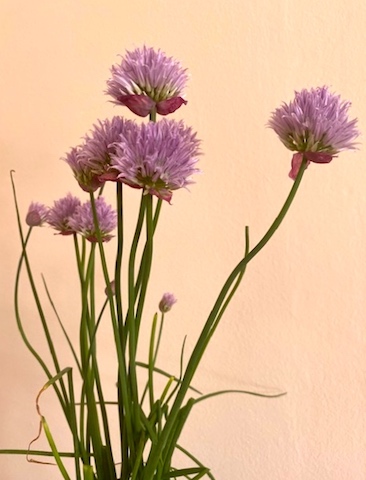
The most effective way to use fresh herbs is to add them as the last ingredient with salt and pepper.  If you have a garden, a single plant of a perennial such as thyme, oregano, sage, mint, tarragon and chives will keep you supplied for the next six months.  These hearty herbs thrive on inattention and will return the following year.  Tender herbs such as parsley, cilantro, rosemary, basil grow quickly in a pot on the patio or in a sunny window sill with an occasional watering.  This month is the best time to get started.

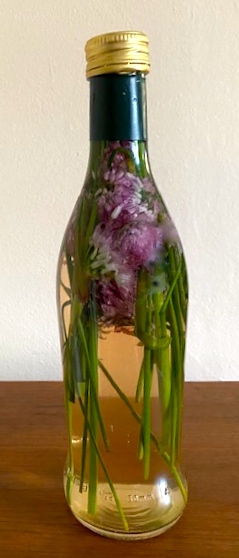
A bunch of fresh herbs purchased at the grocery or farmers' market is an equally good way to start cooking with herbs.  It's a better choice than decimating a newly planted herb when preparing a Carrot Salad with Parsley.  There's also no reason to scrap herb leaves leftover on the counter.  They can be easily preserved in an Herb Butter or Bouquet Garni Vinegar.  With these two products you have instant aromas at your fingertips.

Wishing you many aromatic highs this summer!


  • Written by Madelaine Bullwinkel

EVERY DAY IS 'EARTH DAY'

A post-pandemic world is coming into focus for those of us lucky enough to live in countries where a vaccine is readily available.  Yet this is hardly a high five moment.   Despite the heroic efforts of scientists and doctors, the rapidly mutating coronavirus continues to rage in poorer countries.  While we wait in hopes this virus will become a preventable disease, each of us can help combat one environmental foe that is hiding in plain sight. 

It is time to take action to reduce plastic litter to which we contribute every day.  It is is just one of the many issues signatories to the Paris Agreement will address, we don't know when.   There is current legislation being proposed in Illinois to restrict single-use plastic that will surely be stymied as it has been elsewhere by preemptive bans sponsored by the plastics industry.  Meanwhile, 11 million pounds of plastic will enter Lake Michigan again this year.  In the words of my childhood heroine, little red hen, when no one could help:  ‘I will do it myself."

Plastic is the kind of valuable innovation whose usefulness has outstripped our need for it.  The first synthetic polymer was invented in the 1870’s specifically to save wildlife.  Plastic billiard balls replaced ones made from the tusks of elephants who were being hunted to extinction; a comb made of plastic saved the hawksbill turtle whose shell was prized for combs.  Archival vaults filled with celluloid reels hold the invaluable history of  photography and the film industry.  And let’s not forget how the introduction of nylon stockings seduced and freed women in the 1930’s.

We can’t say we weren’t warned about the potential for the explosive growth of plastics in the last fifty years.  Do you remember the business advice Dustin Hoffman received In the 1967 film The Graduate albeit from one of his father’s drunk friends?  “ I have just one word for you,” he said, “Plastics!”  That throw-away line was uncannily prescient.  We now have to try to undo the mess  we failed to anticipate.


Here is a short 'do' list of measures I am adopting to shrink my plastic footprint:


        1.      Take small expandable mesh bags to the market to hold loose produce; take large recyclable sacks to hold all purchases.
        2.      Carry a refillable water bottle.  Avoid drinks sold in one-use plastic bottles.
        3.      Look for staples sold in recyclable containers rather than plastic.  Reuse unavoidable plastic containers at least once but never reheat food in them.
        4.      Return to the practice of buying whole heads of salad greens.  Store them in a one pound container that previously held mixed greens.
        5.      Continue to sort and recycle plastic containers and single-use plastic bags.

A change in daily habits takes time and effort.  I can attest to that.  It also leaves one with the sense of being, in a small way, empowered. 

I hope some of you have already developed habits that reduce your use of plastic.  Do you have suggestions you would like to share?   Please send them!

  • Written by Madelaine Bullwinkel

SPRING ARRIVES IN A CLOVE OF GARLIC


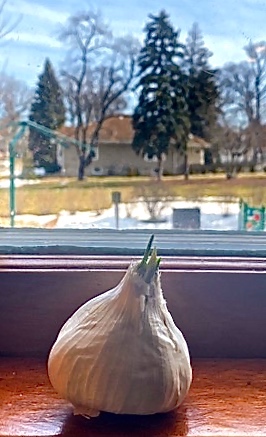
Three green blades sprouted from a head of garlic on my kitchen counter in early February as snow covered the ground outside my window.   Soon green shoots appeared at the base of all onions that crossed my cutting board. How did these bulbs know it was time to grow into new plants?

The discovery that all plants contain a molecular clock that triggers their growth was made almost a century ago. Research began in Japan in the 1930's as a means to improve rice production. The stems of rice plants were collapsing before they set seed seriously limiting crop yields. Scientists found five hormones that work in tandem to stimulate and guide the growth of plants from dormancy through flowering.

My sprouting head of garlic had spent time in cool darkness before coming to market. During that time a molecular acid called gibberellin was gathering strength. In the warmth of my kitchen this hormone broke the garlic’s dormancy and set the bulb’s cells in motion to produce the next generation. The next question.  Could gibberellin also initiate renewal in the human microbiome?

A few quick internet searches led me to ads for over-the-counter garlic supplements with added gibberellin and hormone-fortified sprays for plants. As many as 130 different sources of gibberellin acid have now been synthesized. None were as appealing as a natural source. Was there a hack for getting a gibberellin rush from garlic?


One would have to eat a raw clove of garlic, whole, to avoid the stink that is released once garlic's sulfur cells are activated by chewing.  And the odor remains on ones breath as garlic slowly metabolizes and is vaporized in the lungs. I'm impressed by garlic's many health benefits, but I'd rather not make social distancing a way of life.

In the hands of a savvy cook, garlic will morph from it's raw Dr. Jekyll personality to a sweet Mr Hyde in minutes. Chopped garlic’s offensive sulfur compounds gradually disappear in a hot skillet leaving the carbohydrates free to break down and sweeten, up to a point.  Cooked a second too long, these sugars turn bitter and the garlic becomes inedible. Spoiler alert: There's no proof that gibberellin's magical powers can survive the heat of an oven or skillet.

So, I console myself with a steaming bowl of soup made with the simmered whole cloves of four heads of garlic. Braised and pureed garlic is sweet and restorative.  The addition of a poached egg and toast makes it a satisfying lunch and leaves me feeling fortified for the coming season.


GARLIC SOUP

Ingredients for 4 servings:

4 heads fresh garlic, peeled or unpeeled

1 bunch of fresh thyme (6-8 stems)

1 quart vegetable or chicken broth or water

Juice of 1 lemon

Kosher salt and freshly ground pepper

4 slices country bread, toasted

4 poached eggs

Garnish: smoked Spanish paprika

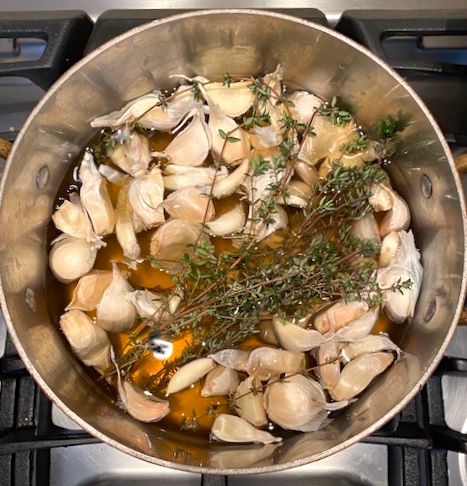
Break the heads of garlic into cloves, discarding the loose wrappings. Place cloves, peeled or unpeeled, and thyme stems in a saucepan, and cover with stock or water. Bring liquid to a simmer, and cook uncovered at a bare simmer for 15 minutes, or until the cloves are just tender. Remove the thyme stems and the garlic cloves with a slotted spoon. Pass unpeeled cloves through a food mill. Puree the peeled cloves with a cup of garlic broth. Return the garlic to the soup, add the lemon juice, and season to taste with salt and pepper.


Place the toasted bread rounds in the bottom of each soup bowl and pour on the soup. Garnish with a poached egg and sprinkle on paprika. Serve hot with a chilled glass of fruity white wine.