A+ A A-
  • Written by Madelaine Bullwinkel

A THANKSGIVING POUTINE

 The old saying, ‘never say never' certainly applies to food tastes.   Here is a case in point.  If told I would one day publish a recipe for Quebec’s signature dish, poutine, my response would have been an emphatic, "Never!”.  I wouldn't blog about French steak frites either.  Both are iconic dishes but poutine has always sounded 'over the top'. Just the thought of French fries covered with cheese curds and a ladle of gravy gives me indigestible.  But, what do I know?

It took the intervention of my my son-in-law, Amid, and a recipe from the Sikh candidate for Prime Minister of Canada to cure me of my 'never poutine' attitude.  In an unlikely sequence of events, Amid, who rarely cooks, watched parliament member Jagmeet Singh prepare a curried poutine in a Tweet to his many followers.  Amid made his poutine; loved it and offered to show me how to show me how to make it while I was in Montreal.  I couldn't refuse and followed him into the kitchen.


The backstory gets better.  Singh had chosen October 14, Thanksgiving Day in Canada, to Tweet his poutine describing it as his favorite holiday dish.  As he expertly sliced onions and stirred the curds, he riffed on how a poutine with curry seasonings symbolized the integration of his Punjab origins and his present life in Canada.  It was a brilliant but insufficient campaign tactic.  A week later Justin Trudeau narrowly won reelection as Prime Minister.  Jagmeet Singh who placed third in a field of six remains a member of Canada’s Parliament and leader of the New Democratic Party. 

Jagmeet posted a photo of his handwritten recipe for Punjabi Poutine two days after the Tweet.  It reveals poutine’s vast                  potential for substitution.  In his recipe cubed and fried sweet potatoes replace French fries.  A spicy tomato sauce stands in for gravy.  The constant is cheese curds.  

Canadians appear to be addicted to these virtually tasteless blobs of white cheese.  Small bags of curds sit next to the cash register in many Montreal food shops.  Their dryness allows them to remain stable at room temperature. The best curds are so dry they squeak when you bite into them.  That is one of the pleasures of eating poutine.


I like to imagine that the first poutine was created in 1950's Quebec by an inventive short-order cook in a small roadside diner along a snowy two-lane highway.   It’s early on a frigid Saturday morning and his bleary-eyed customers are revelers looking for a hangover cure and exhausted long-haul truckers.  Poutine, with its hot, crisp fries, squeaky cheese and mouth-coating meat gravy filled the bill and continues to satisfy to this day.

https://twitter.com/theJagmeetSingh/status/1183756574210158592


  • Written by Madelaine Bullwinkel

TAKEAWAYS FROM SOUTHWEST FRANCE


The Vezere River from Site de la Madeleine

Visitors to the serene valley of the Vezere River in southwest France come prepared to discover exciting links to human prehistory A single road along the river connects carefully preserved sites where homo sapiens found shelter and food some 20,000 years ago.  At Site de la Madeleine (no relation, the name refers to time period) I could envision standing guard on a ledge above the river scanning for boats from shelters upstream. On a tour through the newest cave replica of Lascaux, we all gazed with childlike wonder at herds of enormous animals painted on the walls of its narrow passageways.
Replica of cave paintings at Lascaux IV
Our English guide at the Museum of Prehistory in nearby Les Eyzies-la-Tayac showed us examples of early man's technical prowess as hunter and artist. Museum displays of recovered objects are interspersed with dioramas and videos that demonstrate how skillfully early man made weapons and turned softer pieces of animal hide and shells into elaborate headdresses. (A beautiful example is in the collection of Chicago's Field Museum.)  
This phantom world of distant past evaporated as we drove through in the rolling Dordogne countryside.  Gaggles of ducks and geese have replaced the thundering herds of bison and antelope.  Confit of duck and foie gras appear on every menu.  Prehistoric residents would be amazed to see the handsome chateaux and fortified villages built along the Vezere since the 12th century century as global warming after the ice age allowed plants and woodlands to flourish.
                        
View of the town of Montignac on the Vezere River and Confit de Canard
Our quest for an Saturday market was easily filled in nearby Sarlat-le-Caneda, a town first settled in Gallo-Roman times.  The town center swells in the morning with tourists and locals eager for locally grown foods and regional specialties. At stop for coffee in Place de la Liberte, the heart of the market, allowed us to time travel again as we watched shoppers and vendors play out their time-honored roles against the backdrop of the 12th century Cathedral of Saint Sacerdos. That evening in Montignac, we dined on market ‘finds’ in potluck fashion: cheeses from Rocamadour and the Auvergne; bread baked in a wood-fired oven; thinly sliced smoked duck breast; fresh walnut cake and an assortment of locally-grown strawberries.  All of it washed down with local wine from Cahors.
A trip to southwest France would be incomplete without a visit to the winemaking area of Bordeaux.  The most surprising takeaway for me, having let almost two decades elapse since my last visit, was the dramatic change in winemaking practices underway.  Bordeaux wines are traditionally made predominantly with cabernet sauvignon grapes that are structured to mature over a period of 10 to 20 years.  We learned as we toured properties in Saint Emilion that 85% of the wine purchased today is drunk within 48 hours.  This news whetted my appetite (sorry) to learn more about 21st century winemaking in Bordeaux on future visits.
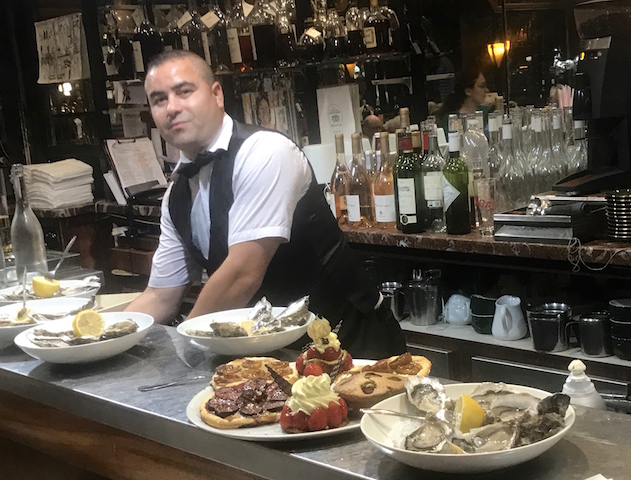
Bar in a Bordeaux Bistro on a Saturday evening
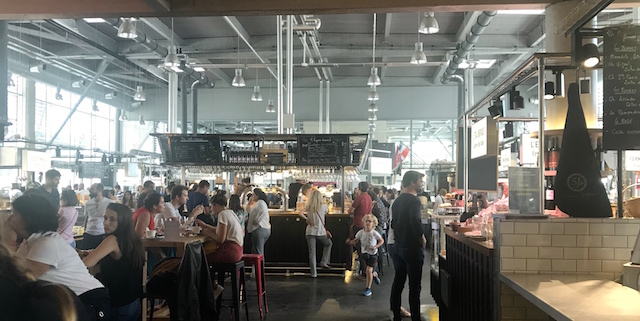
Our group of travelers spent the final afternoon in Bordeaux's 'golden triangle' of luxury shops for gifts to take home. Another takeaway was the new energy I sensed in this ancient port city.  Bordeaux now has an extensive tram system that accelerates travel through the city center, out into the surrounding winegrowing areas and along the wharf whose once abandoned warehouses are now filled with small shops and dining spots.  An ambitious wine museum, Cite du Vin, opened in 2016 and across the street a barn-like food mall called Les Halles de Bacalan awaits anyone interested in casual dining elbow-to-elbow with les bordelais.  Where else can you find a food stand that specializes in an assorted flavors of chocolate mousse?
 
Les Halles de Bacalan on Sunday Afternoon 


  • Written by Madelaine Bullwinkel

"Chopped" Comes to Chicago


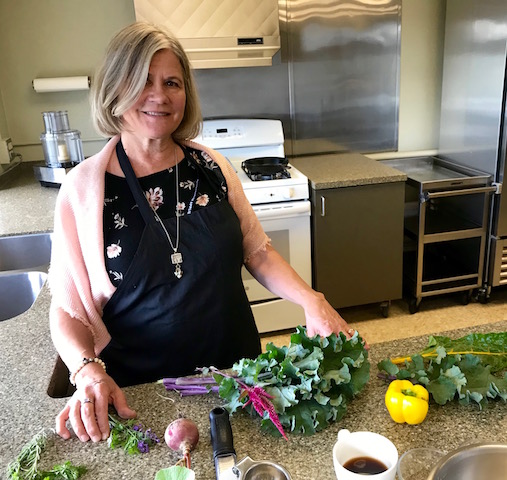
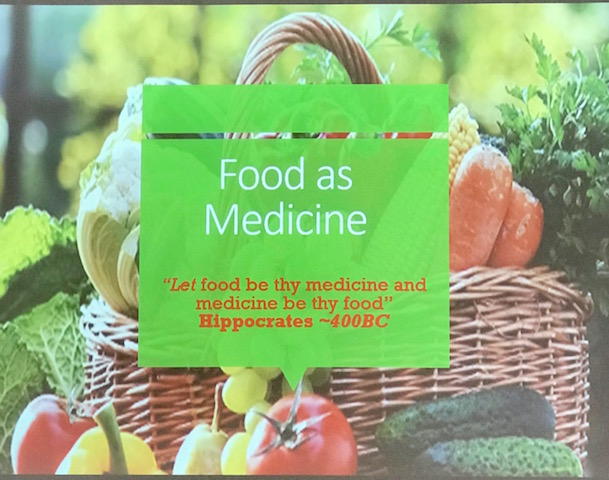
A "Chopped Challenge" worthy of the Food Network was staged in a spacious kitchen on the University of Illinois Chicago campus last Saturday.  Three teams of nutrition students and alums gathered around stainless steel tables prepared to plan, cook and plate an original dish.  The time had come for these budding health professionals to illustrate how well they they could show that food is the best medicine. 
 
 
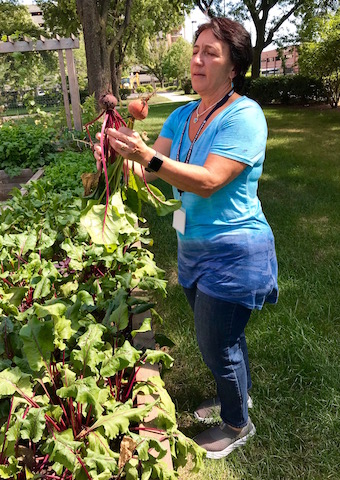
The event began in the luxuriant kitchen garden planted behind the Applied Health Science building where contestants picked vegetables, edible flowers and herbs for their creations.  They had access to the kitchen's pantry but picked sparingly from an array of purchased grocery items at their disposal.  Each team was assigned a nutrition student to run the food processor, saute onions and act as a gofer.  
 
The pressure was on once they began.  Contestants had forty-five minutes to complete a dish while keeping in mind the ten judging criteria as well as the USDA's MyPlate Dietary guidelines. Their challenge didn't end there.  The mystery ingredient that day was the notoriously bland, firm-fleshed filet of fresh cod.


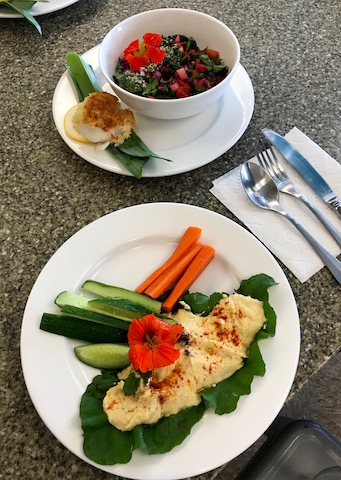
The first team created a meal rather than a dish. It consisted of a hummus starter, a mixed vegetable salad and an entree of pan-fried cod.  Team members had agreed on three elements, made assignments and worked without conferring with each other. When it came time to plate their dish, the lack of coordination was obvious.  The three preparations didn't fit on the plate nor did they complement one another.  The cod was properly cooked and crispy but lacked enough seasoning. 


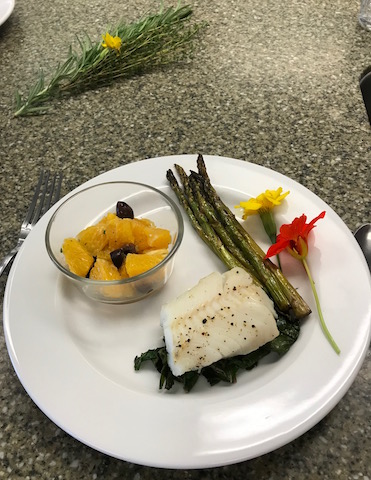
The second team developed a Mediterranean theme binding the elements on the plate with the flavor of oranges.  The roast cod filet was glazed with orange juice and nested on a bed of  sauteed kale.  Slim roast asparagus stalks were also brushed with fruit juice.  The compote of orange sections and black olive turned out to be the most flavorful element on the plate.  For all this harmonious flavor interplay, the disjointed plating made eating difficult. The asparagus stalks required a knife and fork. The flaky cod proved hard to balance on a fork with the kale.  And the compote fell off everything but a spoon.  Enjoying all these flavors in one bite was nearly impossible.
 
 
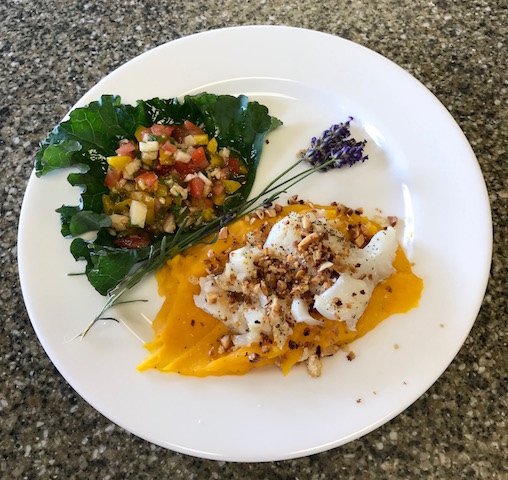
The preparation of the winning plate began with a setback that the team turned into an advantage.  When baked butternut squash came out of the oven, it was too soft to cube as planned and had to be pureed.  It made a delicious and attractive bed for skillet-baked cod.  This team overcame the cod's large flake texture by breaking the filet into pieces as it cooked.  The garnish of toasted garlic and chopped almonds was an inspired, sophisticated and delicious.   A crunchy raw kale leaf filled with a salsa of fresh fruits, vegetables, lime juice and cilantro was a refreshing complement.  And it was easy to eat!