A+ A A-
  • Written by Madelaine Bullwinkel

WHO'S AFRAID OF HOLLANDAISE?

HollandaiseCover

When Chicago shuts down, as it did this past Sunday morning under a foot-deep blanket of snow, there's only one recourse.  Get out the cast-iron skillet and prepare a hearty winter breakfast.  At our house, that means Eggs Benedict.

When you love breakfast, you always have the essential ingredients, in case, for example, you should want to have breakfast at dinnertime.  I'm serious.  Supplies include English muffins (in the freezer), thick sliced bacon, eggs and Hollandaise sauce.  What?  You don't  have a jar of  Hollandaise next to the mayo in the door of your refrigerator?  It's time to remedy that situation
 
Leftover Hollandaise, like mayonnaise can be safely stored in the refrigerator from week to week.  When you want to restore it to a rich, coating consistency, simply whisk it tablespoon by tablespoon, off the heat, into a hot tablespoon of whipping cream and lemon juice.  Want a thicker sauce?  Whisk in  melted butter after the cold sauce, adjust the seasonings and Voila!  The Hollandaise sauce is ready faster than you can poach an egg.

Of course, you have to make sauce Hollandaise first.  In terms of technique, making Hollandaise is very much like making mayonnaise, with the addition of heat.  Both sauces start with yolks beaten with vinegar or lemon juice into which oil in the case of mayonnaise or butter with Hollandaise is slowly added.  An illustrated description follows:

HOLLANDAISE SAUCE
Four Servings:
1 large egg yolk at room temperature
1 teaspoon cool water
1 teaspoon lemon juice
1/4 teaspoon sea salt
2 tablespoons cold unsalted butter
5 tablespoons unsalted butter, melted
Additional lemon juice
Freshly ground white pepper
Garnish: Freshly chopped chives
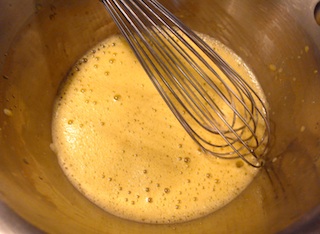
Hollandaise1


 Fig. 1:  Combine and whisk the yolk, water, lemon juice and salt until frothy.  Whisk in two tablespoons cold butter, one at a time, with the pan over low heat.  Continue warming this mixture until the bottom of the pan can be seen with each whisking motion.  The liquid should lightly coat the bottom and sides of the pan.  Off the heat, gradually whisk in the melted butter.  Season to taste with more lemon juice and freshly ground white pepper.

Hold the sauce in a hot water bath (100 degrees) for 2-3 hours, or in a thermos for 6 hours.

Leftover Hollandaise will break if it's warmed directly over heat, but the chilled sauce can be whisked back to life by adding it to a little bit of cream and lemon juice.  (A broken mayonnaise can be whisked back into an emulsified state by adding it slowly to a teaspoon each of mustard and vinegar,)   Any sauce remaining after serving this reincarnation goes back into the refrigerator, awaiting its next use.   With repeated heatings the proportion of egg yolk to butter in the sauce diminishes.  You can reverse that process by using the cold leftovers to start the next recipe of Hollandaise.
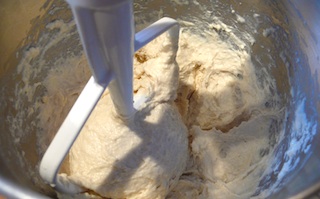
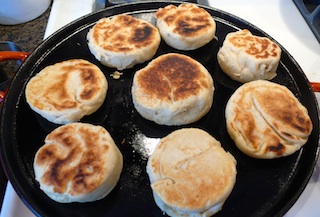
EngMuffins3EngMuffins2EnglishMuffins

Link to English Muffin Recipe


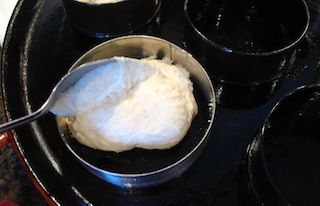
Those of us who dote on breakfast take advantage of the leisurely pace of a snowed-in Sunday morning  to make English muffins.  The dough requires a minimum of staple ingredients (flour, water, yeast and salt) and rises in one hour.  Muffins cook quickly on a hot griddle, dropped in free-form rounds or spread in metal hoops (or repurposed tuna fish cans).  Check to see they reach the internal temperature of 200 degrees on instant-read thermometer.

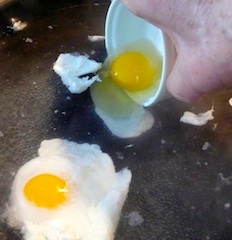
When it's time to poach the eggs, I add a teaspoon of salt and a tablespoon of white vinegar to boiling water in an eight inch skillet.  Instead of breaking them directly into the water, I open each egg into a ramekin and gently pour them into the water.  An offset spatula or fork comes in handy at this point to release the egg from the bottom of the pan.
PoachEggs


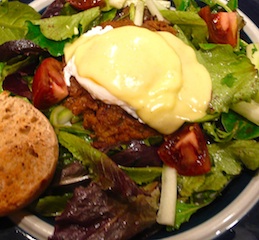
A plate of Eggs Benedict calls for a side of bacon, either Canadian bacon, thick-sliced applewood smoked bacon, even duck bacon (Maple Leaf Farms).   For Mardi Gras, I will be serving poached eggs and Hollandaise sauce over large crab cakes (see below)..  When spring finally arrives, there will be Hollandaise for asparagus and salmon.  I could go on, but it's starting to snow again.  Time to reach for my skillet.
HollandaiseCrab

Mardi Gras Eggs with Hollandaise on a  Crabcake


FYI:  I will be teaching these recipes and more in late May at the Alliance Francaise de Chicago.  Look for details this spring on the Home page of www.chezM.com or the Alliance Francaise.
  • Written by Madelaine Bullwinkel

A VERY CRANBERRY CHRISTMAS

CranChrist2

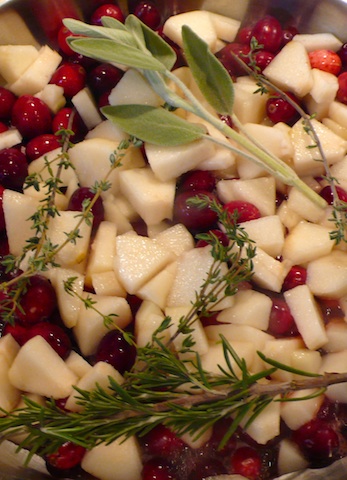
Cranberry Pear Compote with Fresh Herbs (link)

The humble cranberry, once just a canned Thanksgiving staple, recently morphed into a sexy 'superfruit' and is fast becoming a victim of its own success. This year's crop has flooded the marketplace. You are helping to reduce the surplus every time you drink cranberry juice, snack on Craisins, sip a cranberry martini or dose your immune system with pharmaceutical grade cranberry powder. But, as one grower put it, "It's time to get more creative."

Let me put the problem in perspective. Our neighbor to the north in Wisconsin produced 60% of the country's supply this year, a whopping 600 million pounds. It's the largest crop ever, and we are likely to consume just 20% of it between Thanksgiving and Christmas. Witness the  bargain-priced bags of cranberries piled high in supermarket showcases.

CranChrist1

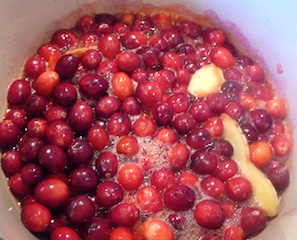
Cranberry Ginger Jam (link)

Here's what you can do to help.  First, stock your freezer with bags of fresh cranberries. Then go to the recipe archive at www.chezm.com and type 'cranberries' in the search box. No fewer than 24 recipes will appear! The jam, compote and sauce recipes call for fresh berries. (Bread, cookie and salad recipes use the dried ones.) There's sure to be a least one that you can work into a holiday meal at your house.

What am I doing to take advantage of the great cranberry glut?  Every year I concoct a new cranberry jam recipe and fill small quarter-pint preserving jars to give as gifts. This year's flavor combines cranberries, Granny Smith apples, fresh ginger slices and, of course, a fair amount of sugar.

CranChrist3

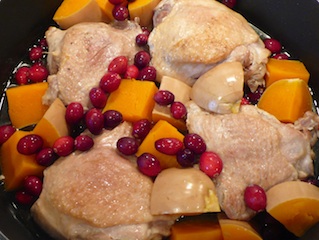
Turkey Thighs with Butternut Squash and Fresh Cranberries (link)

 For the more adventurous I recommend going off-recipe and simply strewing fresh cranberries into simmering poultry and pork dishes. Tart cranberries have a refreshing way of accentuating the natural sweetness in these meats. If this sounds a bit primitive, it is.  I'm channeling native Americans who pounded cranberries to wild game meats and fat to make pemmican, our nation's first energy bar.

Go wild with cranberries this year. Have a berry, berry Christmas!


  • Written by Madelaine Bullwinkel

LE PONT DU GARD

PontduGard2

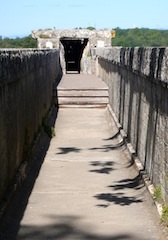
Watercourse channel across the Pont du Gard

As the TGV high-speed rail service whisked me from Paris to Avignon last month, I wrote out grocery lists for meals my tour clients would  prepare in the coming week.  I imagined shopping the weekly markets in Uzes for succulent black figs, plump wild mushrooms and newly cracked brine-soaked Picholine olives.  Staring at the Evian bottle on my tray table, I also flashed on the most precious commodity in Provence.  Water.

Visits to the remarkable Gallo-Roman sites in Provence are as essential to understanding its culture as is its cuisine.  The Pont du Gard is the Romans' spectacular solution to perennial problem of moving water to where people can best use it, in this case, Nimes, thirty miles south.  A morning visit is a ‘must’ on our week-long Provence Odyssey.   

PontduGard


There is so much to marvel standing below a massive barrel vault of this three-tiered Roman bridge.  It may be a UNESCO World Heritage site (since 1985), but it is only a fragment of the 31 mile long Nimes Aqueduct most of which is underground.  Two thousand years ago this covered watercourse carried 200,000 cubic meters of spring water from Uzes, 11 miles to the northeast, over the Gardon River, to the garrison town of Nimes, twenty miles away.   Parisians, by comparison, did not have freshly piped water until the middle of the 19th century.

A wonderful archeological museum at the left bank entrance explains everything you could ever want to know about the aqueduct’s exacting construction.  The gradient along its route, for example, was only 56 feet.  It drops only one inch along the entire 365 yard length of the Pont du Gard!  To encourage the flow, of water, the interior channels were carefully prepared with olive oil and maltha, a mixture of pork fat, slaked lime and the thick juice of unripened figs.  Before I leave the museum I have to watch the three minute 'bird's-eye-view” video taken from the one-man ultra-light airplane as it follows the water's route under the rolling plains and through shrubby terrain of the Department of Gard.

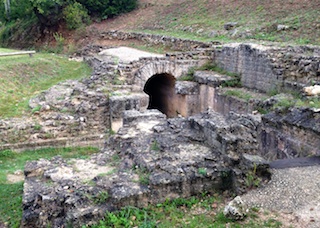
AquaductUzes

Remains of Uzes Aqueduct

This year I rented a house in charming medieval town of  Uzes where abundant springs supply the town's water supply even today.  My walk down from the town to the remains of the Roman aqueduct, however, required the perseverance and climbing skills of a mountain goat. The town’s tourist map shows its location but once off the street, the path is unmarked.   Steep steps down to the river consist of an uneven series of switch-backs, with no handrails for support.

I found the limestone remnants of the aqueduct and a single marker easily in open meadow.  One would never guess this relic was in any way related to the carefully landscaped Pont du Gard.  I complained at the mairie (town hall) in Uzes and at the tourist office about this neglectful treatment of their patrimoine (the French are very proud of their heritage).  The officials I spoke to at each location told me the other was the responsible party.  

NimesLogo


The city of  Nimes, on the other hand eagerly embraces its Roman heritage.  It has adopted a modern logo of a stylized crocodile chained to a palm tree.  This is a reference to Julius Caesar’s conquest of Egypt in the successful Battle of the Nile in 47 BC.  Caesar retired his Roman legionaires from that campaign here and gave them small plots of land to farm .

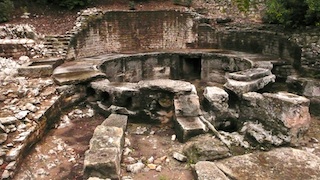
The ancient watercourse made its entry into Nimes at  Le Castellum, an easy ten minute walk from the historic Maison Carré with the help of the city map.  It consists of a shallow circular basin and the vestiges of channels that carried water out to the city that had 60,000 residents in the middle of the 1st century AD.  A decline in the upkeep of the aqueduct accompanied the weakening of the Roman Empire and its fall in the fourth century.  The water was further reduced to a trickle by the 6th century when calcium build-ups from the limestone walls began to fill the channels.

LeCastellum

Le Castellum