A+ A A-
  • Written by Madelaine Bullwinkel

STAY-AT-HOME GRILLED CHEESE WITH ONIONS AND APPLES
The importance of keeping a daily routine is one of my favorite pieces of unnecessary advice we have received to help us survive this long period of social isolation.  Who among us has not had a daily routine since forever and can’t create a new one in a heartbeat?   The real challenge, is to nudge ourselves forward in everything we do, to evolve rather than simply tread water from day to day. 

 Mealtimes are a good example of opportunities to balance the comforts of familiar with the pleasures of novelty.  Under normal circumstances, daydreaming about what to eat next is considered a distraction.  It becomes a distinct advantage when a family spends the day together.  Dinner doesn’t have to be the’ big meal of the day.  Confinement erases this hierarchy.  In this moment we can rethink lunch as a family affair.
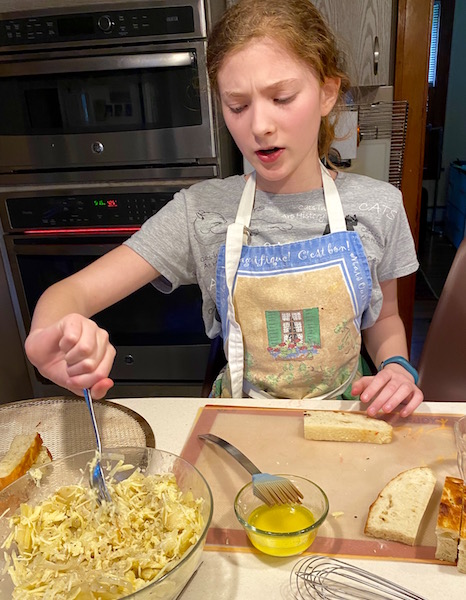
 

 ROSEMARY ASSEMBLES A GRILLED CHEESE SANDWICH

Grilled cheese is the first hot sandwich that American children learn to eat.  Its popularity lies in the way its warm, crunchy bread and gooey cheese consistency briefly overwhelms the senses.  How else could a sandwich made with flavorless industrial grade bread and cheese become so famous?  There's no question, the grilled cheese sandwich is a prime candidate for a makeover. 

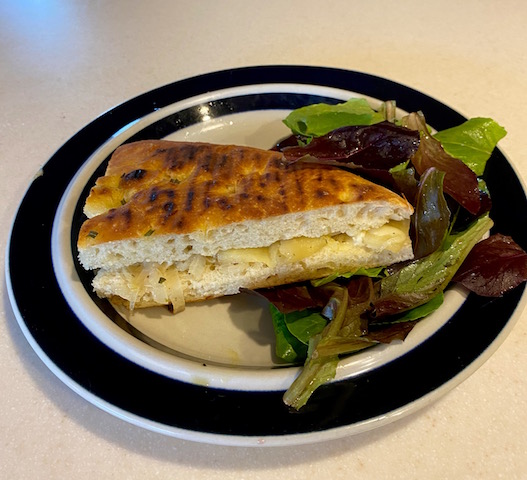
My current version accentuates the tender, unctuous mouthfeel of grilled cheese with the addition of slowly cooked onions and apples.  The crisp, toasty fragrance of home baked focaccia (see my recent blog) adds a satisfying contrast.  There are many possible variations on this theme for you to explore.  Sliced Vidalia onions would make a sweeter choice; they require more attention because they get mushy quickly.  A baguette or sourdough country bread slices could easily replace the focaccia.  With any bread, cut slices no more than 1/2” thick so that the cheese melts before the bread becomes too dark. I chose a dried herb seasoning because it can withstand a long cooking time.  Fresh chives, thyme or parsley added just when the onions finish cooking would be even more aromatic. 
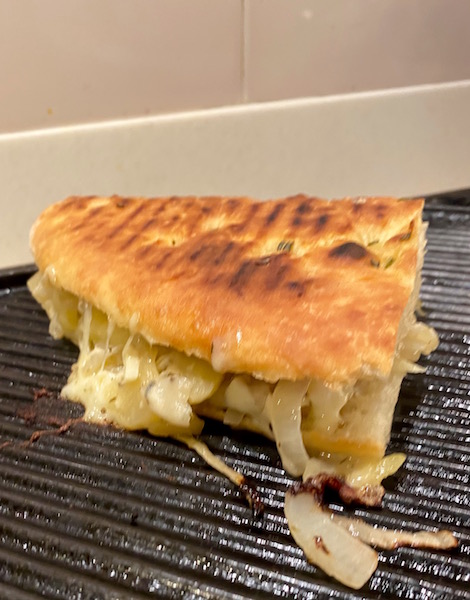
GRILLED CHEESE SANDWICH WITH ONIONS AND APPLES

Ingredients for 4 sandwiches

3 tablespoons unsalted butter

1 pound onions, halved, peeled and thinly sliced

1/2 pound Granny Smith apples, peeled, quartered, cored and thinly sliced

1 teaspoon kosher salt

freshly ground white pepper, to taste

1/2 teaspoon dried herbes de Provence

4 ounces Gruyere cheese, grated

1 loaf focaccia

3 tablespoons unsalted butter, melted.

Melt the butter in a large, heavy skillet.  Add the onion and apple slices, stir to coat them, cover the pan, and cook over medium low heat for 5 minutes.  Remove the lid stir in the salt, pepper and herbes de Provence, and continue cooking until the mixture is soft, another 20-25 minutes.  Off the heat, fold in the grated cheese so that the mixture is somewhat cohesive.

Preheat a grill or griddle.  Cut the focaccia into slices no more than 1/2” thick. Place a thick layer of the onion mixture between slices.  Brush the top slice of each sandwich with melted butter and place it facing down on the grill applying some pressure.  Butter the surface of the slices facing up on the grill.  Turn when the bottom slice is browned, about 3 - 4 minutes, depending on the heat of the grill.  Grill another 3 minutes, or until the cheese begins to ooze out of the sandwich.  Serve immediately with a green salad.


  • Written by Madelaine Bullwinkel

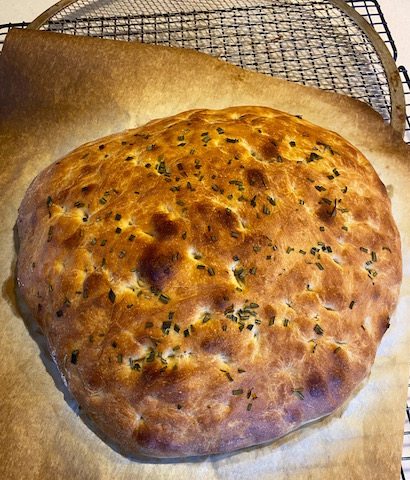
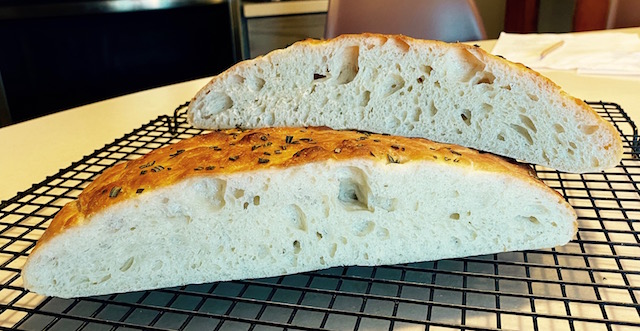
STAY-AT-HOME NO-KNEAD FOCACCIA

Home cooks are constantly searching for their next culinary ‘fix’,  be it an update of a familiar dish or an exotic recipe from another part of the world.  Our kitchens counters are littered with time-saving equipment that deliver perfectly whipped egg whites, pureed pistou, and foam-capped espresso.  Rarely does a recipe achieve worldwide acclaim with four ingredients, untended rests and a hot oven  

Such was the seismic response by home cooks to Jim Lahey’s No-Knead Boule recipe in The New York Times Good Eating section in November 2006.  Lahey’s recipe contains less yeast, more water with a consistency easily mixed by hand.  The dough rises slowly at room temperature and then is refrigerated overnight or longer.   Still too soft to knead, the baker simply turns it into a Dutch oven to bake when desired.   The result is an expanded round of flavorful bread, with a light, chewy texture and crisp, brown crust.  How could a dough that requires so little labor and is so amenable to the baker’s schedule make such terrific bread?

The chemistry is as basic as it is compelling.  A long rise allows yeast to proliferate as it feeds on the flour’s incomplete starch and sugar.  Yeast activity produces alcohol and carbon dioxide which is trapped in the flour’s gluten strands causing the dough to rise.  Home bakers have always kneaded dough to develop its gluten.  Little did we suspect that the dough will structure gluten naturally in a wet dough given enough time.  Home bakers who relied on kneading to work out their frustrations are encouraged to join a gym.

Several books, including one by Jim Lahey, have expanded the No-Knead technique to a wide variety of breads. The recipe that Catherine Damme sent me contains a little olive oil to aid in stretching the dough into flatbreads for focaccia and pizza.  Unlike the original boule recipe which is baked in kettle, this dough can be assembled in the morning and baked in the afternoon for dinner.  Our current stay-at-home condition offers first time and experienced bread bakers an unrivaled opportunity to work ‘the staff of life’ into their daily routine.  


NO-KNEAD OLIVE OIL DOUGH 

Ingredients for 1 large loaf

3 3/4 cups unbleached white flour

1/2 tablespoon instant yeast

2 teaspoons kosher salt

1 tablespoon sugar

1 2/3 cup water (at 100 degrees)

2 tablespoons olive oil

Focaccia:

2 tablespoons olive oil 

1 teaspoon minced fresh rosemary 

Mix the flour, yeast, salt and sugar together in a large bowl.   Make a well in the center and pour in the water and olive oil.  Work the dry into the wet ingredients to form a rough dough.  Transfer the dough to another bowl that has been brushed with olive oil.  Cover the bowl with plastic wrap, and leave in a sheltered place for 2 hours.  Transfer the bowl to the refrigerator for 3 hours to firm it.  

Remove the bowl from the refrigerator, place a pizza stone in the oven, and turn the temperature to 475 degrees.  Lightly dust a circle on a piece of parchment.  Scrape the dough onto the floured parchment and lightly flour the surface of the dough.  Working with floured finger, smooth and stretch the dough into a 14”  round.  Allow the dough to rest for 20 minutes as the oven heats.  

Poke to the bottom of the dough with fingers to create a pattern of holes. Brush on the olive oil and scatter on the rosemary.  Slide the parchment onto a pizza screen or a cookie sheet.  Place the focaccia on the stone and turn up the oven to 500 degrees.  Bake for 15 - 20 minutes until the bread is golden brown.  Remove the bread and slide it off the parchment onto a cooling rack.  Cut when warm or at room temperature.

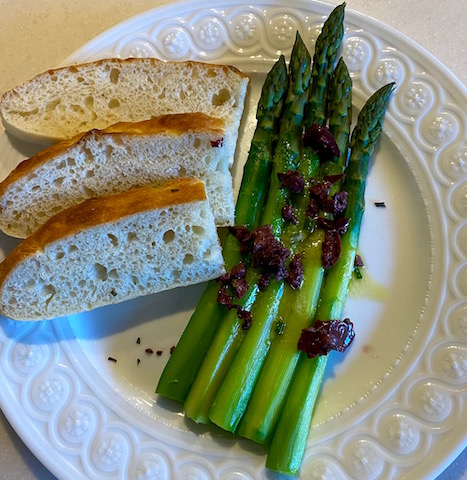
 ASPARAGUS WITH LEMON VINAIGRETTE AND CHOPPED  KALAMATA OLIVES


  • Written by Madelaine Bullwinkel

STAY-AT-HOME WHITE BEAN, ROSEMARY AND RED PEPPER GRATIN

Yesterday our governor ordered Illinois citizens to shelter-in-place until the end of May.  Another five weeks of eating your own cooking can be good news if you are ready to expand your repertoire.  Who knows, we may find ourselves homebound again.  We’d better be ready with recipes!

To that end, I’m taking my own advice and testing dishes I’ve cooked from scratch with their equivalent in shelf-stable ingredients.   It’s a challenge I confronted  years ago when asked to teach recipes using USDA donated canned goods at the Greater Chicago Food Depository.  I will begin now as I did then with a key ingredient in my pantry and assemble jars of items that are complementary.                 


Everyone who has recycled leftovers with grated cheese and breadcrumbs has made what the French call a gratin.  Layering the ingredients and toasting the breadcrumbs gives it a 'gourmet' look. When shopping for processed foods, select those containing five or fewer ingredients and less than 10% sodium.  All you have to do is read the label.

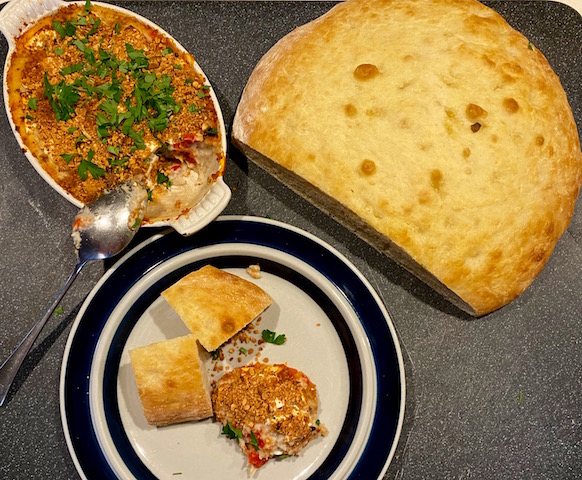
I chose to make this gratin with cannellini beans as my key ingredient.  These large, creamy beans come in handy as a base for a soup, stew or salad when I don’t have time to soak dry beans overnight and cook them in advance.  The fresh rosemary and bottled chili peppers in this gratin were inspired by a recipe in The Basque Kitchen by San Francisco chef Gerald Hirigoyen.  (I have to confess a fascination with the courageous and independent Basque people.  In the 16th century Basque sailors rowed up the Atlantic coastline from Northern Spain to Iceland, Canada and into America waters.  They arrived before Columbus, not as colonists, but as commercial whalers and cod fishermen.  One of their sayings is, “To know how to eat is to know enough.”) 

Do you believe in serendipity?  The morning I began this post, blog reader Catherine Damme sent me a link to a recipe from the Washington Post for No-Knead Olive Oil Bread.  How could she know it is the perfect bread to serve with this  gratin?  No-Knead Focaccia will be the subject of my next post.

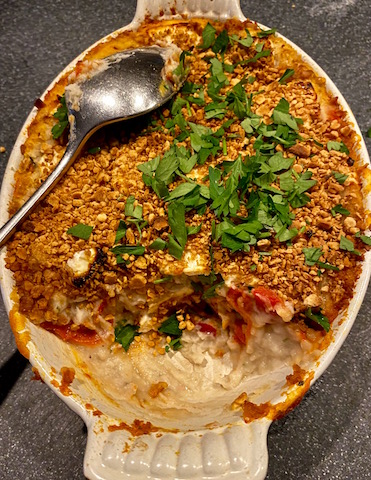
WHITE BEAN, RED PEPPERS AND ROSEMARY GRATIN

Ingredients for 8 servings:

26 ounces canned or boxed cannellini beans 

2 tablespoons olive oil

1 teaspoon finely chopped fresh rosemary or 1/2 teaspoon dried

2 tablespoons vegetable broth or water

1 teaspoon sea salt

4 ounces chopped red peppers (piquillo peppers or Hatch chilis)

4 ounces feta cheese, sliced

3 tablespoons Panko crumbs, toasted

1/4 teaspoon freshly ground white pepper

2 tablespoons freshly minced parsley 

Preheat the oven to 475 degrees.  Lightly oil a 2 1/2 cup gratin dish. 

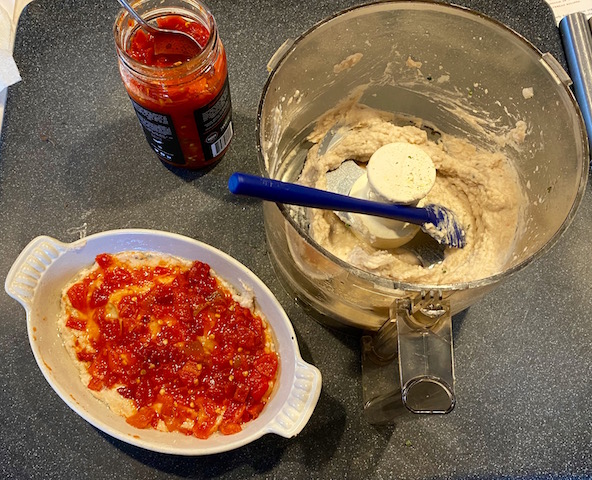
Drain, rinse and puree the beans in a food processor or blender.  Add olive oil, rosemary and vegetable broth or water, and run the machine another 15 seconds.  Season to taste with salt. 

Spread 1/3 of the bean mixture in a even layer over the bottom of the gratin dish.  Spread half the pepper pieces on the bean puree.  Repeat these two layers and end with a layer of beans.  Lay the thin cheese slices over the beans.

Toast the Panko crumbs in a dry, non-stick skillet until they are a light brown. Scatter the crumbs and white pepper over the surface of the gratin.  Bake for 15 minutes, until the surface is browned and crisp.  Scatter on the parsley and serve with No-Knead Olive Oil Bread.  (to follow)