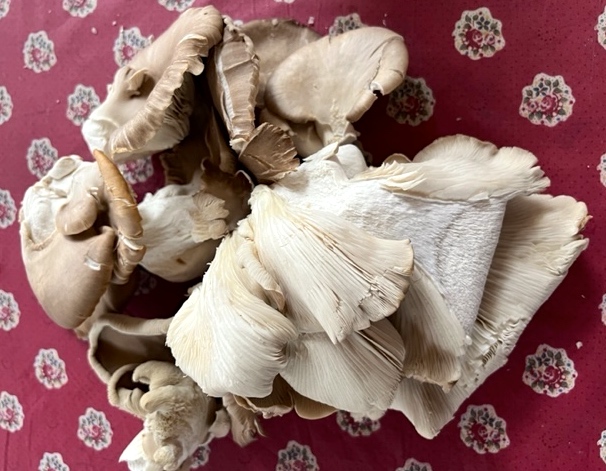
- Written by Madelaine Bullwinkel
DEPARTMENT OF TASTE: UMAMI
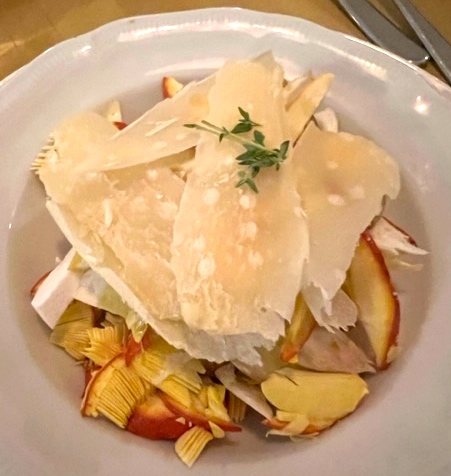
I was served a dish as sensational as Proust’s madeleine in Bologna last fall. It consisted of only two ingredients: cep (porcini) mushrooms and aged Parmesan cheese. They arrived at the table, a loose pile of bite-size fresh mushroom pieces covered with broad, paper-thin slices of aged Parmesan cheese. What this pairing lacked in eye-appeal it more than made up for when eaten. Their combined flavor was overwhelming delicious
My initial reticence to consume a raw wild mushroom dissolved after a couple of bites. So did my assumption that cooking would have improved their tastes. The synergy of their combined flavors was magic in my mouth.
I will admit that until that moment, umami, was a taste I did not fully appreciate. In my defense, scientifically verified taste receptors for umami were confirmed just 23 years ago. What Asian cuisine had already discovered a century before was finally codified in the west But I’m getting ahead of myself.
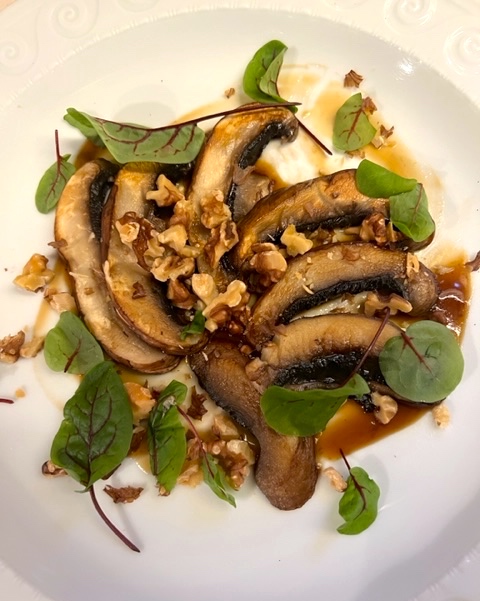
Skillet Roasted Portabella Mushrooms with Coffee and Walnuts
The word umami is a rough translation of the Japanese word for ‘deliciousness’. Japanese chemist Kikunae Ikedi identified the amino acid, glutamate, as the source of the savory flavor in dashi, a broth of seaweed and dried fish that is fundamental to Japanese cuisine. A year later, Dr. Ikeda and an entrepreneurial partner introduced a salt of glutamic acid, MSG, on the commercial market. A umami hack was born.
Glutamate is an important regulator of cognition, memory and mood in all plants and animals. A fair amount of umami is present in our diet of eggs, meat, fish, vegetables (especially tomatoes and mushrooms) and nuts. Glutamate levels are also high in fermented foods such as cheese and cold cuts. How recent is our awareness of umami? The ancestry of Asian fish sauce can be traced back to garam, the fermented condiment that the Romans added to everything.
The addition of MSG to Asian cuisines has been commonplace for almost a century. Its commercial use in the States since 1950's has been the source of controversy. A small percentage of sensitive diners have complained of headaches, dizziness and other short-term discomfort from MSG. These effects have not been replicated in scientific tests, but the FDA now requires MSG to be listed as an ingredient when it is present in manufactured food products.
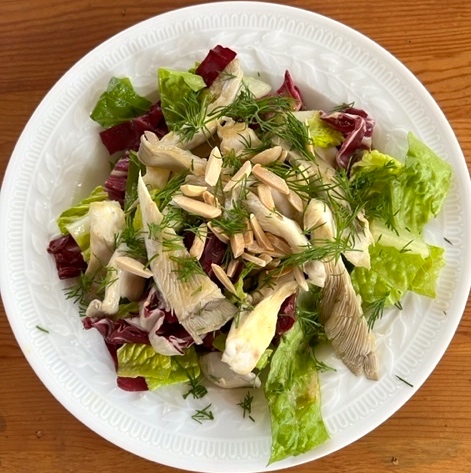
Radicchio and Mushroom Salad with Lemon Anchovy Vinaigrette
My umami conversion in Bologna was the result of an intuitive pairing of two glutamate-rich ingredients. The intense concentration of sweet, salty and sour tastes created by the bacterial activity in aged Parmesan intensified the mushroom’s earthy richness. All the taste receptors on my tongue were operating at full capacity.
Since my return from Italy, I have attempted to recreate that magical synergy in my cooking. The recipe for Skillet Roasted Portabella Mushrooms with Coffee and Walnuts is adapted from the website of the Harvard T.H. Chen School of Public Health. The sauce contains a spectrum of tastes that accentuates the taste of the mushrooms and walnuts. The Radicchio and Mushroom Salad with Lemon Anchovy Vinaigrette is my own creation with oyster mushrooms and almonds with a vinaigrette enabler. Both recipes have encouraged me to adventure into new taste combinations in the service of umami.
Enjoy!